
All-round insulation.
The ultra-thin shield against noise, heat and damp.
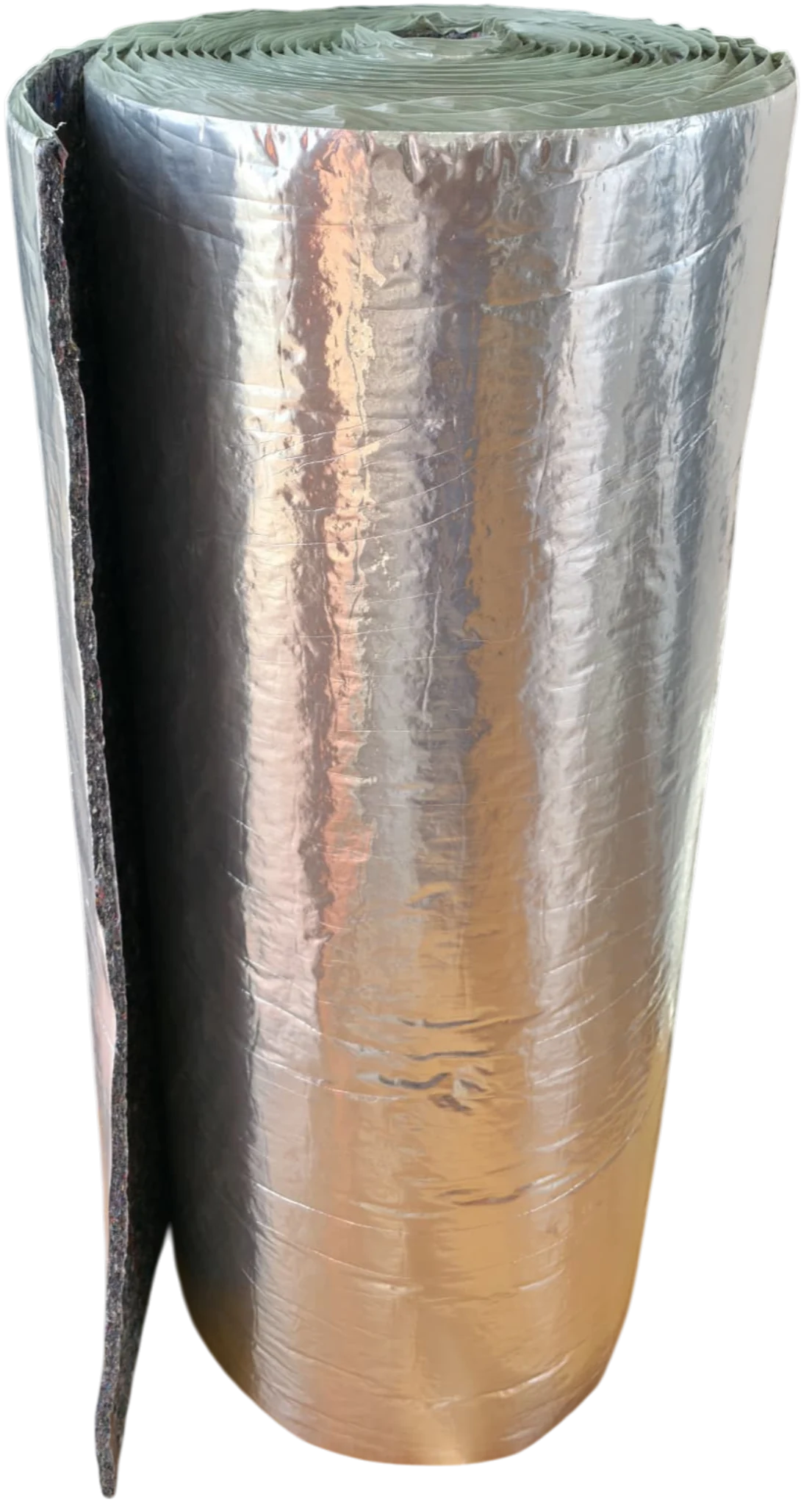
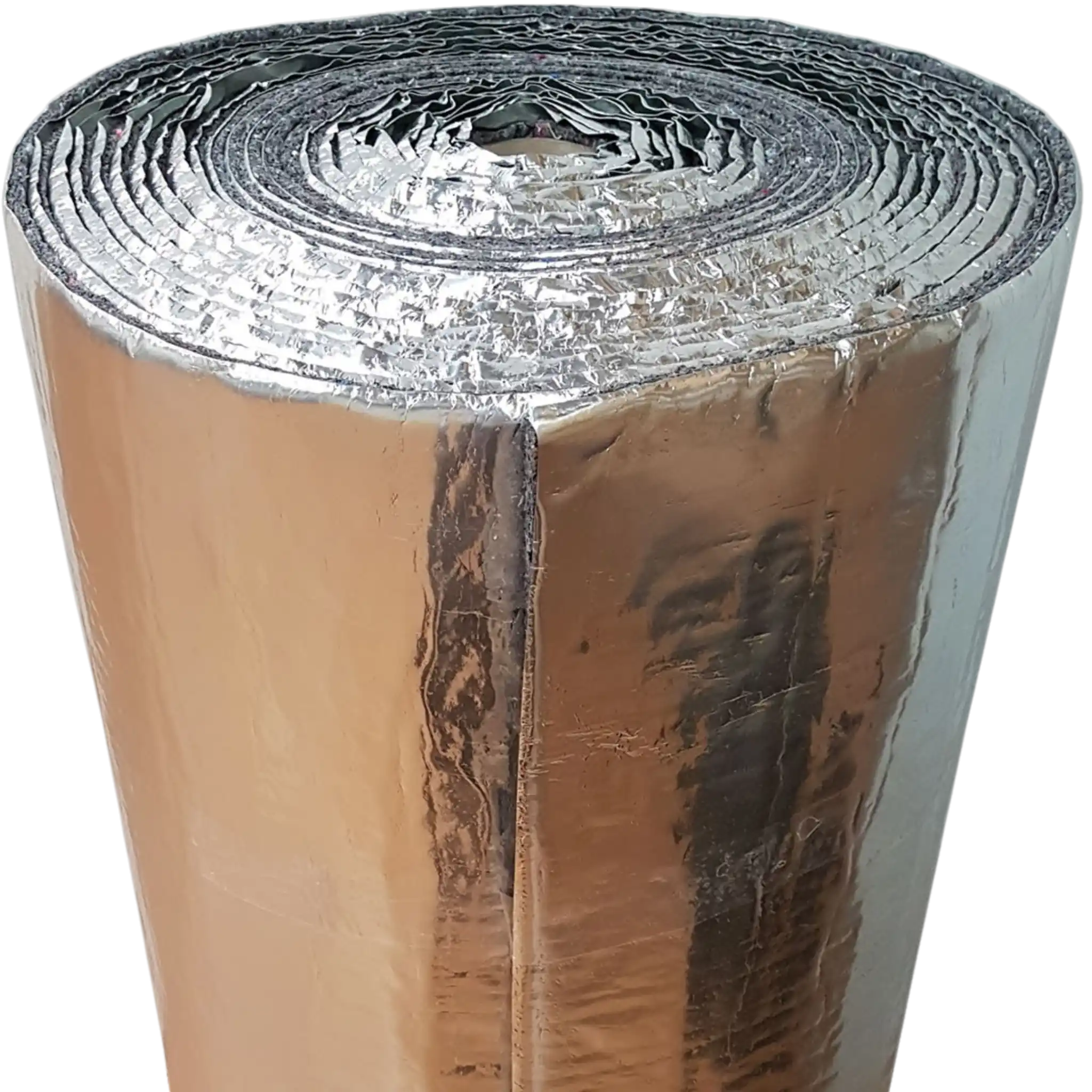
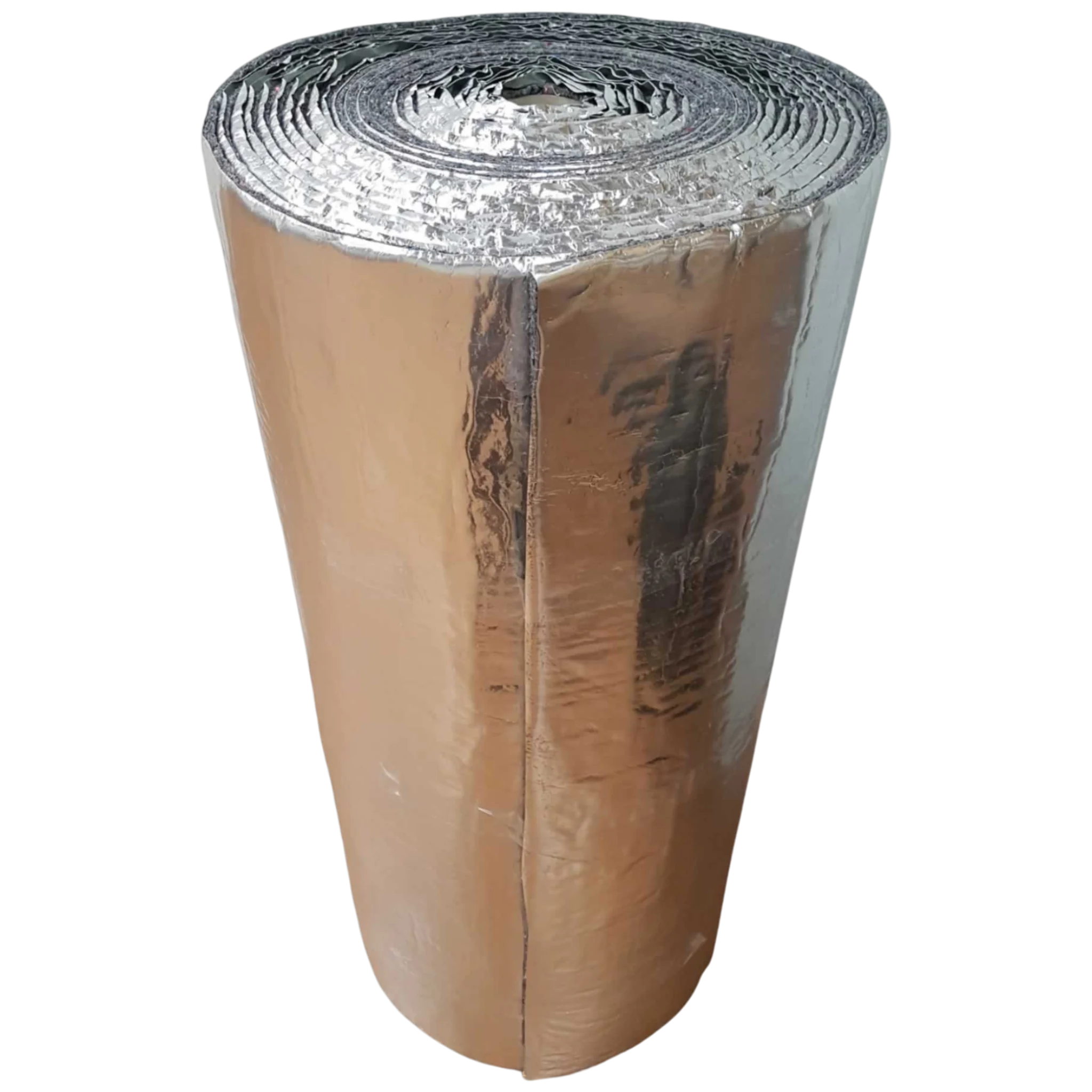
The slim 3-in-1 insulation: soundproofing, thermal reflectivity and vapour barrier.
Three functions in a single installation, less than 10 mm thick.
play_circle_filled Overview and benefits of R'Acoustic Alu
Discover R'Acoustic Alu in this video
The 3-in-1 shield: sound, heat, vapour
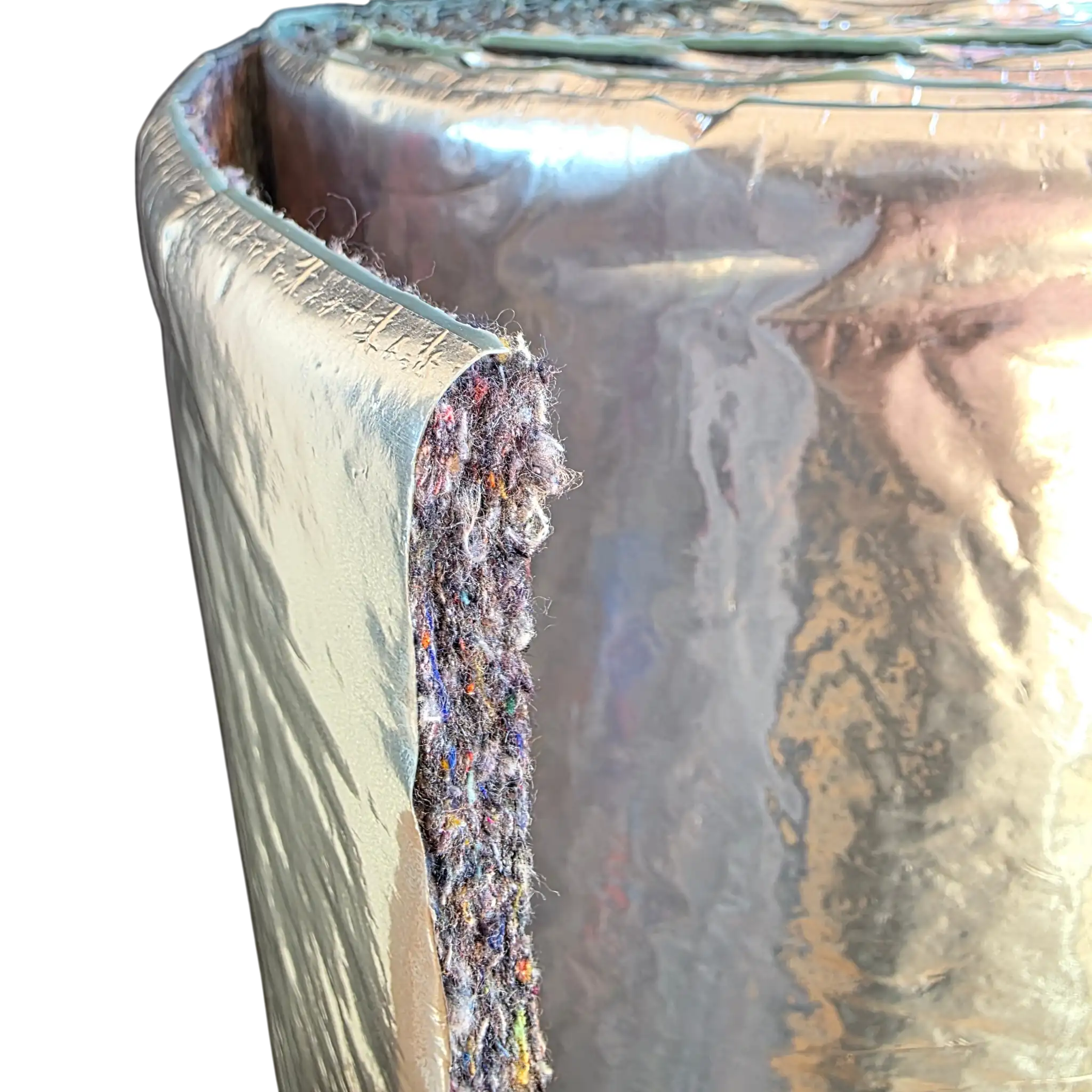
R'Acoustic Alu combines three functions in a 10 mm thickness. Its surface, made from glue-free, thermally bonded recycled textile fibres, absorbs airborne noise (manufacturer’s indicative figure: 23 dB) and reduces impact noise (ΔLw index measured at 27 to 33 dB depending on the screed, CEIS Madrid test, ENAC). Its pure aluminium surface reflects infrared radiation and forms a continuous vapour barrier. Understanding R'BULL reflective technology.
Space-saving and eco-design
Made from recycled textile fibres (wool, cotton, synthetics) thermally bonded without glue, R'Acoustic Alu achieves a high density of 130 kg/m³ for 1.30 kg/m², with a thickness of just 10 mm. Compliant with REACH (Regulation (EC) No 1907/2006) and RoHS (Directive 2011/65/EU). Indoor air quality index A. Ideal for insulating walls, ceilings and underlays without encroaching on living space.
Where to install R'Acoustic Alu
Four main areas of application: walls, ceilings, floors and under screed. Its versatility makes it a thermal and acoustic insulation material suitable for both renovations and new builds, for internal installation protected by a thermal barrier compliant with Article AM8 (brickwork, plasterboard or levelling screed).
Hover over the structures to view the insulation areas.
Technical data and performance
| Technical data | |
|---|---|
| Trade name | R'ACOUSTIC Alu |
| Manufacturer’s reference | BOLTHERM 510, manufactured by Boltherm LDA, Covilhã, Portugal |
| Insulation thickness | 10 mm |
| Roll dimensions | Width 1.20 m, length 20 m Total area: 24 m² |
| Composition | Glue-free, thermally bonded recycled textile fibres (wool, cotton, synthetic fibres) + 7 µm pure aluminium face protected by 50 µm polyethylene |
| Weight per square metre | 1.30 kg/m² |
| Density | 130 kg/m³ |
| Thermal conductivity (λ) | 0.036 W/m·K Measured by CEIS Madrid (ENAC 1/LE1175), UNE-EN 12667:2002, report CAT0109/12 |
| Thermal resistance (R) | 0.28 m²·K/W for 10 mm installed Derived from λ = 0.036 W/m·K. R = 0.80 m²·K/W measured directly on 3 stacked layers (30 mm) |
| Emissivity of the aluminium side | ε = 0.05 (reflectance 95%) |
| Dynamic stiffness (s') | 16 MN/m³ CEIS Madrid test, UNE-EN 29052-1:1992 (impact method) |
| Impact sound reduction (ΔLw) | 27 to 33 dB depending on the density of the sand-cement screed Calculated in accordance with EN 12354-2:2001 based on s' = 16 MN/m³ |
| Airborne sound insulation | 23 dB Manufacturer’s data (Boltherm) |
| Reaction to fire | Euroclass E-s1-d0 in accordance with EN 13501-1:2002 Suitable for installation in public buildings in accordance with Article AM8 under a fire barrier (¼ h for vertical walls, ½ h for ceilings or floors) |
| Compression | Maximum 2,000 kg/m² · permissible (10% deformation) 1,000 kg/m² |
| Operating temperature | -25 °C to +85 °C |
| Indoor air quality | Class A |
| Regulatory compliance | REACH (Regulation (EC) No 1907/2006), RoHS (Directive 2011/65/EU) Boltherm LDA declarations dated 13 November 2025 |
| Packaging and logistics | |
|---|---|
| Roll(s) per package | 1 |
| Weight of one roll | 31.2 kg (24 m²) |
| Packages per pallet | 6 |
| Area per pallet | 144 m² |
| Weight of a pallet | 187.2 kg |
| Standard delivery | France 48–72 hours Europe 1 week |
| Origin |
|
| EAN code | 3760372520083 |
CEIS Madrid test report
Verifiable measurements of thermal and acoustic performance. Report CAT0109/12, ENAC accreditation 1/LE1175.
- Thermal conductivity λ = 0.0361 W/m·K (UNE-EN 12667)
- Dynamic stiffness s' = 16 MN/m³ (UNE-EN 29052-1)
- ΔLw 20 to 33 dB depending on screed density
The values marked ‘Measured by CEIS Madrid’ are taken from test report CAT0109/12 dated 03/01/2013, CEIS laboratory accredited ENAC 1/LE1175. The terms “manufacturer’s data” refer to Boltherm’s internal measurements provided for information purposes only, not derived from an independent accredited test. The full report can be downloaded above.
Frequently Asked Questions about R'Acoustic Alu
Technical, well-sourced and factual answers. The product’s limitations are acknowledged without making any false promises.
For which types of work is R'Acoustic Alu really suitable?
R'Acoustic Alu is designed for four areas: walls (party walls, drywall lining), ceilings (partition walls between floors), under floating timber floors (reduction of residual impact noise) and under levelling screed (the best-documented application, noise reduction ΔLw 27 to 33 dB depending on screed density). It is not suitable for roof insulation: the performance indicators and fire class E do not justify its use in this configuration.
Why state 23 dB airborne sound reduction rather than a measured Rw value?
The Rw index is, by definition, measured on a complete wall tested in an independent laboratory (for example, R'Acoustic 20 has an Rw of 50 dB, tested at LNEC on a specific configuration). For the R'Acoustic Alu, no Rw wall test has been carried out in an accredited laboratory. The value of 23 dB is a figure provided by the manufacturer Boltherm based on internal measurements, for information purposes only. We display this in a fully transparent manner, without presenting it as a standardised index. For impact noise, however, we have verifiable data: ΔLw 27 to 33 dB depending on screed density, calculated in accordance with EN 12354-2:2001 based on the dynamic stiffness s' = 16 MN/m³ measured by CEIS Madrid.
Can R'Acoustic Alu be installed in public buildings?
Yes, provided it is installed in accordance with Article AM8 of the amended Decree of 25 June 1980. R'Acoustic Alu is classified as Euroclass E-s1-d0 in accordance with EN 13501-1:2002. Any insulation thicker than 5 mm that is not classified as A2-s2-d0 must be protected by a thermal barrier providing ¼ hour of resistance in vertical walls or ½ hour in ceilings or floors. Standard configurations are compliant: masonry partition, plasterboard, levelling screed. For specific specifications for a public access building project, please contact our technical support.
How does this differ from R'Acoustic 20 or R'Acoustic 10?
The three products form Ceilingo’s high-density textile acoustic sub-range, but with distinct positioning. The R'Acoustic 20 (20 mm, 90 kg/m³, Rw 50 dB tested by LNEC) is the product with the highest airborne sound reduction performance, designed for demanding acoustic requirements. The R'Acoustic 10 (10 mm, 110 kg/m³) is the slimmest version for confined spaces. R'Acoustic Alu (10 mm, 130 kg/m³, aluminium face) adds a thermal reflective function and an integrated vapour barrier, for configurations where the building envelope must also manage water vapour migration.
Can R'Acoustic Alu replace conventional thermal insulation?
No. R'Acoustic Alu is primarily a sound insulation material. Its aluminium face provides an additional thermal reflective function (thermal conductivity λ = 0.036 W/m·K measured by CEIS Madrid, thermal resistance R = 0.28 m²·K/W for 10 mm installed), which is useful as a supplementary insulation layer to block infrared radiation. However, it does not replace primary thermal insulation in roofs, lofts or external walls. For these applications, see the R'BULL technology in the reflective thermal range.
Is it compatible with floating parquet flooring?
Yes. Laid loose under floating parquet (laminate, engineered), aluminium side facing upwards. Impact noise reduction varies depending on the density of the flooring (ΔLw 20 to 29.5 dB for dry floors according to the CEIS report, informative annex EN 12354-2:2001). For parquet glued to a screed, see the levelling screed configuration, which is better documented.
Compatible with a levelling screed?
Yes, this is the best-documented configuration for the product. Installation on sand-cement or anhydrite screed. Impact sound reduction ranges from 27 to 33 dB depending on the density of the screed (60 to 160 kg/m³), calculated in accordance with EN 12354-2:2001 based on the dynamic stiffness measured by CEIS Madrid. The product’s permissible compression (1,000 kg/m² at 10% deformation, maximum 2,000 kg/m²) is compatible with standard loads for a residential floor.