
Forget thickness. Demand performance.
R'BULL technology,
thin reflective insulation.
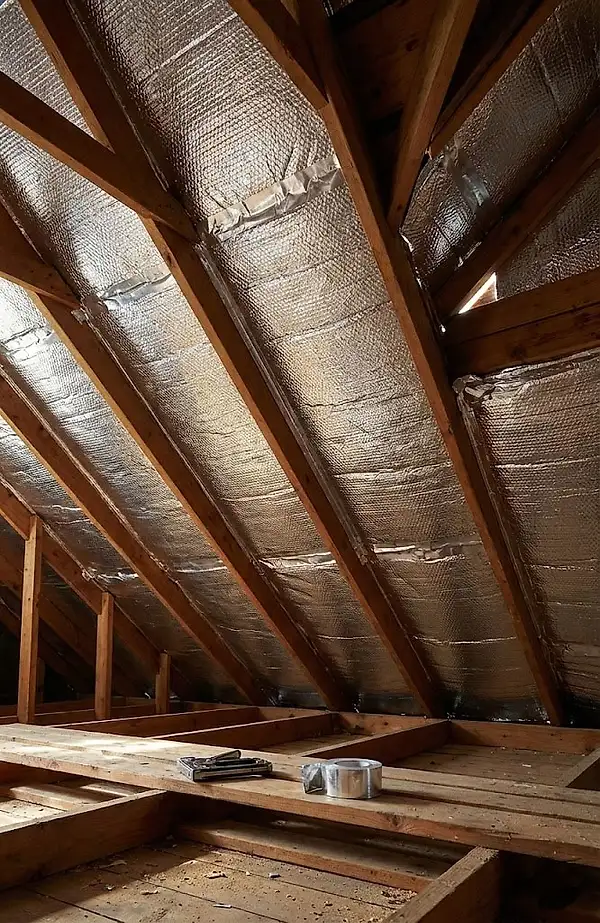
A low-emissivity aluminium face that reflects infrared radiation, and a honeycomb structure that traps still air. From 5 to 20 mm thick, to tackle summer heat where there isn't room for more thickness.
What is R'BULL technology?
R'BULL technology is a thin reflective insulation process developed by Ceilingo. It combines two mechanisms: a low-emissivity aluminium face that reflects infrared radiation instead of absorbing it, and a honeycomb structure that traps still air to slow convection. Thickness ranges from 5 to 20 mm, depending on the reference.
The emissivity and thermal resistance of R'BULL products are measured in accordance with the ISO 22097:2023 standard, which specifically governs reflective insulation products. The range is based on the BOLTHERM product range, covered by European Technical Assessment ETA 22/0178. Reaction to fire is classified B-s1, d0.
A reflective insulator doesn't behave like a bulk insulation product. Its performance depends on three inseparable elements: the emissivity of the aluminium face, the presence of an unventilated air gap on each side, and the direction of heat flow. It's this whole system, not the product alone, that is declared in the Declaration of Performance.
How does a thin reflective insulation work?
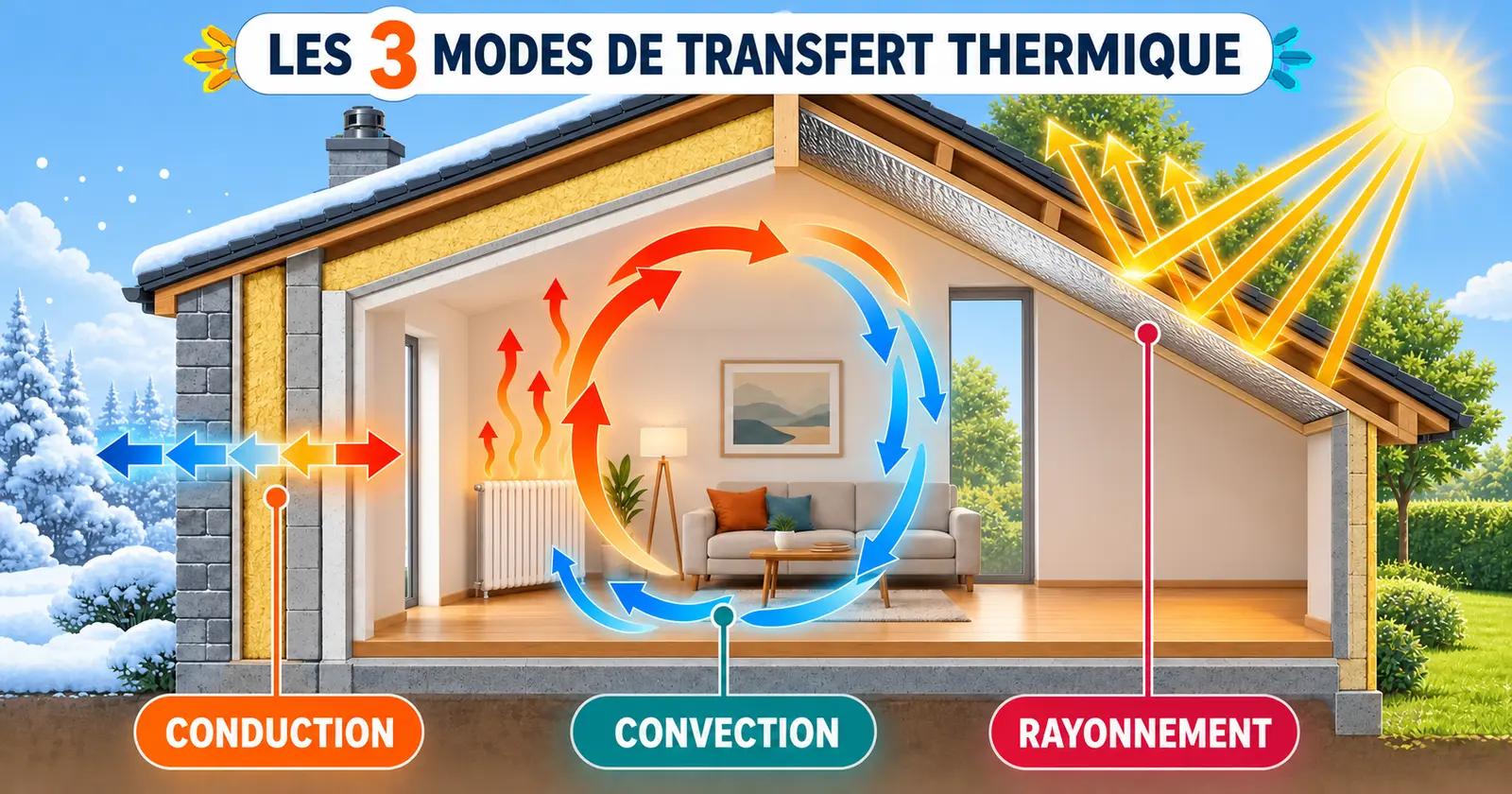
Heat transfers in three ways: radiation, convection and conduction. Under a roof in summer, infrared radiation is the dominant mode. R'BULL technology targets that one first.
Low-emissivity aluminium face
An aluminium surface emits little and reflects a lot. The emissivity measured by the LNE is 0.043 for the R'BULL Pro 10 and 0.053 for the R'BULL Pro 13 (report P254377 DMSI/2). Since an opaque surface reflects what it doesn't emit, this equates to 94.7 to 95 % of infrared radiation reflected back. Radiant heat doesn't pass through, it bounces back.
Encapsulated trapped air
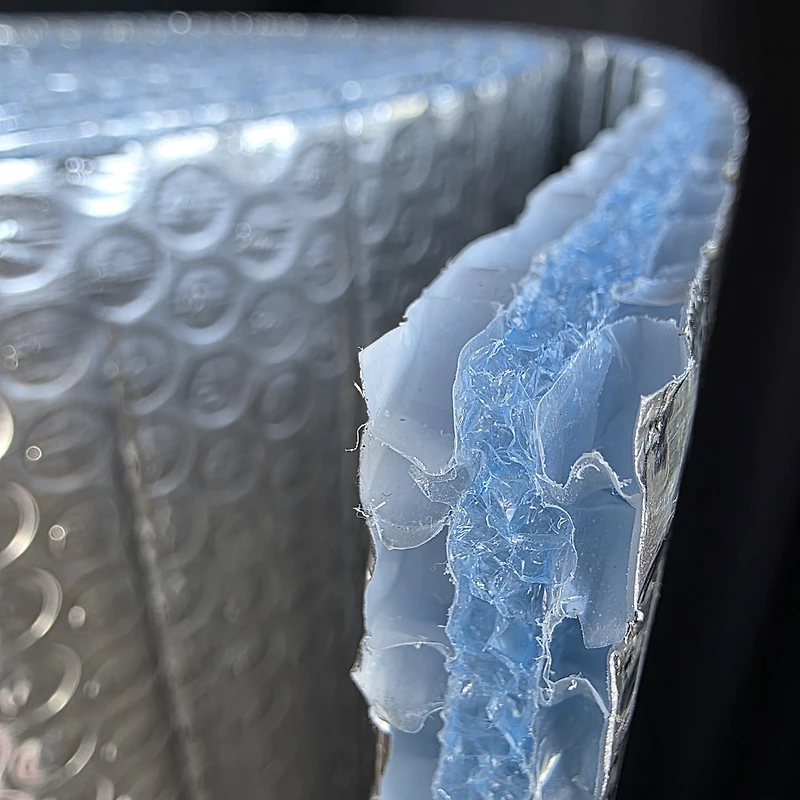
Still air is an excellent insulator; moving air is not. R'BULL traps air inside sealed honeycomb bubbles, which limits convection movements within the product and slows heat transfer. This is what gives the product alone its own thermal resistance, independent of the reflective effect.
The air gap is part of the insulation
A reflector pressed flat against the tile reflects nothing: it conducts. For radiation to be reflected back, there must be a gap between the heat source and the aluminium face. The declared configuration for the R'BULL Pro range is an unventilated air gap of 20 mm on each side of the product. The resistance of this air gap is calculated according to EN ISO 6946, Annex B, in downward heat flow for the summer case.
This is why an R'BULL thermal resistance is always stated as ‘air gap + product + air gap’. Comparing a standalone product to a complete system, or the other way round, makes no physical sense.
What R'BULL technology delivers
Four measurable benefits: summer comfort, living space, fire safety and long-term durability.
Summer comfort
Under a roof reaching 70°C in a heatwave, an insulation product with high thermal mass stores the heat and releases it in the evening. A reflector works differently: it reflects radiation back before it is absorbed, and its effect is immediate. Thermal lag is no longer the only lever; the amount of energy entering is reduced at the source.
A thickness of 5 to 20 mm
In renovation projects, under rafters, behind a wall lining or under flooring, the available thickness is often just a few millimetres. R'BULL fits into these constrained spaces, where a bulk insulation product can no longer be installed without reducing living space. The stated performance remains that of the complete system, including the air gap.
B-s1, d0 fire reaction
The R'BULL Pro 5, Pro 10 and Pro 13 references are classified B-s1, d0 under EN 13501-1: very limited contribution to fire, very low smoke production, no flaming droplets. This is the classification expected in premises open to the public (ERP) in France.
No settling, no rotting
The honeycomb structure doesn't deform and won't rot. The thickness installed stays the thickness in service: no sagging at the top of the rafters, no loss of trapped air, no moisture uptake that would degrade performance over time.
Simulator: thermal resistance and heat flux
Adjust the air gap and the emissivity of the aluminium face under a tile at 70 °C. The calculation follows EN ISO 6946 (Annex B, downward heat flow) and the product's declared resistance.
Ceiling temp.
28.4°C
Heat flux
25.7 W/m²
R'BULL efficiency test
Under a tile at 70 °C, adjust the air gap and the emissivity of the aluminium. The calculation follows EN ISO 6946 (Annex B, downward heat flow) and the product's declared resistance.
Resistance of the product alone: 0.2606 m²·K/W (report KTU 025 SF/26 R). Declared emissivity 0.05, measured 0.043 by the LNE.
The gap between the hot tile and the insulation. Declared configuration: 20 mm. The air gap's resistance increases with thickness, but 20 mm is enough to capture most of the benefit.
Share of infrared radiation reflected back, i.e. 1 minus the emissivity. The declared values are set by the selector above.
Declared values for the R'BULL Pro range
| Characteristic | R'BULL Pro 10 | R'BULL Pro 13 |
|---|---|---|
| Thickness | 10 mm | 13 mm |
| Product family | BOLTHERM 231 | BOLTHERM 235 |
| Emissivity measured (LNE P254377 DMSI/2) | 0.043 | 0.053 |
| Declared emissivity | 0.05 | 0.053 |
| Infrared radiation reflected back | 95.0 % | 94.7 % |
| Thermal resistance of the product alone | 0.2606 m²·K/W | 0.29 m²·K/W |
| Declared thermal resistance of the system 20 mm air gap + product + 20 mm air gap | 1.59 m²·K/W | 1.60 m²·K/W |
| Thermal test report | KTU 025 SF/26 R | KTU 080-1 SF/25 R |
| Fire reaction (EN 13501-1) | B-s1, d0 | B-s1, d0 |
| Measurement method | ISO 22097:2023 | ISO 22097:2023 |
The declared emissivity of the R'BULL Pro 10 is 0.05, under Annex D of ISO 22097:2023, which requires 0.05 to be declared for any measured value below that. The value measured by the LNE remains 0.043. For the Pro 13, the measured value of 0.053 is also the declared value, as this rounding rule doesn't apply.
Standards, tests and reports
Every figure stated on this page refers to a verifiable document. Full reports are available on request from technical support.
- ISO 22097:2023: method for determining the thermal performance of reflective insulation products. This is the measurement method used across the whole range.
- EN ISO 6946, Annex B: calculation of the thermal resistance of unventilated air gaps, for upward, horizontal and downward heat flow.
- ETA 22/0178: European Technical Assessment covering the BOLTHERM product family, the basis of the R'BULL range.
- DoP BOLTHERM 231 and DoP BOLTHERM 235: Declarations of Performance for the R'BULL Pro 10 and Pro 13.
- LNE, report P254377 DMSI/2: emissivity measurement. LNE, report P254377 DEC/4: solar factor.
- KTU 025 SF/26 R and KTU 080-1 SF/25 R: heat flow meter thermal resistance tests.
- EN 13501-1: B-s1, d0 fire reaction classification.
- RTAA DOM 2016: test configuration applicable to France's overseas departments and regions.
A note on terminology. R'BULL products are assessed, not certified. ETA 22/0178 is a European Technical Assessment issued by a notified body, and ISO 22097:2023 is a measurement method. Neither is a product certification. This distinction is deliberate and can be verified in the documents listed above.
Frequently asked questions about R'BULL technology
Eight questions, eight short, sourced answers. Filter by keyword or browse the index.
No, and that's not the claim. In pure thermal resistance, 200 mm of mineral wool remains superior. R'BULL works on a different transfer mode, infrared radiation, where a bulk insulation product is not very effective. The two approaches complement each other. R'BULL is most useful in constrained renovation projects, alongside existing insulation, and for summer comfort. This is covered in more detail on the Responses to criticism page.
The emissivity measured by the LNE is 0.043 for the R'BULL Pro 10 and 0.053 for the R'BULL Pro 13 (report P254377 DMSI/2). The declared emissivity is 0.05 for the Pro 10, under the rounding rule in Annex D of ISO 22097:2023, and 0.053 for the Pro 13. An opaque surface reflects what it doesn't emit, that is 95.0 % and 94.7 % of infrared radiation.
ISO 22097:2023LNE P254377 DMSI/2
Without an air gap, the aluminium face touches the heat source and transmits heat by conduction: the reflective effect disappears. The unventilated air gap is therefore a constituent part of the insulation, not a detail of installation. The declared configuration for the R'BULL Pro range is 20 mm on each side. Beyond that, the air gap's resistance keeps increasing, but very slowly: 20 mm captures most of the benefit.
EN ISO 6946, Annex B
No, R'BULL is assessed. The BOLTHERM family is covered by European Technical Assessment ETA 22/0178, and its performance is measured according to ISO 22097:2023. A European Technical Assessment and a standardised measurement method are not product certifications. Ceilingo deliberately uses the term ‘assessed’, which reflects what the underlying documents actually show.
ETA 22/0178ISO 22097:2023
The R'BULL Pro 5, Pro 10 and Pro 13 references are classified B-s1, d0 under EN 13501-1: very limited contribution to fire, very low smoke production and no flaming droplets. This is the classification level expected for ERP buildings (premises open to the public) in France. The regulatory position for ERP under French Order AM 8 is documented and available from technical support.
EN 13501-1Arrêté AM 8
The Pro 13 is 13 mm thick with a standalone product resistance of 0.29 m²·K/W, compared with 10 mm and 0.2606 m²·K/W for the Pro 10. In a complete system with 20 mm air gaps, the two are very close: 1.60 against 1.59 m²·K/W. The main difference lies in logistics and installation. In a 40-foot container, the Pro 10 covers around 6,000 m², compared with around 4,000 m² for the Pro 13.
DoP BOLTHERM 231DoP BOLTHERM 235
No. The honeycomb structure doesn't deform and won't rot: it doesn't sag under its own weight, doesn't absorb moisture, and keeps its trapped air. The thickness installed stays the thickness in service, including at the top of rafters, where loose-fill or flexible roll insulation is most exposed to settling.
Under rafters and roofs for summer comfort, as a wall lining, in ceilings and in floors. The R'BULL Pro 5S is designed for use as a flooring underlay. In every case, installation must preserve the unventilated air gap that the declared performance depends on. Our network of installer partners and our technical support team can help with installation.
No question matches this filter. Try ‘emissivity’, ‘air gap’, ‘fire’ or ‘installation’.
References that use R'BULL technology
One technology, four thicknesses, four uses.
Find out more
- Summer comfort 2050: insulation and radiation, what changes for buildings under future climate conditions.
- What does ADEME think?, the public position on thin reflective insulation.
- Responses to criticism, common objections addressed one by one.
- The benefits of good insulation, comfort, bills and property value.
- Aid and grants, the schemes available depending on your project.
- Distributors, for professional merchants and resellers.