
Roofs in overseas France: a solar factor of 0.03 at most
In a tropical climate, heat comes in mainly through the roof, and the texts are not read as in mainland France: they combine the solar factor, thermal resistance and, in certain cases, the thermal transmittance. Understanding these quantities means understanding where summer comfort is won and which grants are available.
Key points in 30 seconds
- In Guadeloupe, French Guiana, Martinique and La Réunion, the regulation requires a solar factor of no more than 0.03 for a roof; in La Réunion above 600 metres, a U value of 0.5 W/m².K applies instead.
- The solar factor is calculated: S = 0.074 × Cm × α / (R + 0.2). Three levers, the sunshade, the colour and the thermal resistance.
- Colour weighs as much as the insulant: on a roof, a light shade counts as α = 0.6, a floor value that allows for soiling.
- Grants in France speak two languages: CEE sheets BAR-EN-106, BAR-EN-107, BAT-EN-106 and BAT-EN-108 call for a thermal resistance, sheets BAR-EN-109 and BAT-EN-109 for a solar factor.
- For a roof made up of separate elements, the key document in the file is the solar factor calculation note, dated and signed.
In overseas France, the solar factor becomes an essential quantity
In mainland France, a roof is judged first on its thermal resistance. Overseas, another question arises, and becomes central: how much heat does the roof let in under a sun at its zenith? The answer lies in the solar factor, written S, defined by the order of 17 April 2009, the RTAA DOM, for Guadeloupe, French Guiana, Martinique and La Réunion. The texts and the grants in fact use three complementary indicators: the solar factor S against radiation, the thermal resistance R for insulation, and the thermal transmittance U in certain cases.
For new dwellings, that order sets a maximum, Smax, of 0.03 for horizontal opaque walls, that is to say roofs, and of 0.09 for the vertical opaque walls of main rooms. In La Réunion above 600 metres, the requirement changes in nature: the thermal transmittance replaces the solar factor, with a maximum of 0.5 W/m².K on a horizontal wall. Martinique and Guadeloupe have since applied their own thermal regulations, the RTM and the RTG, which follow the same logic. In Mayotte, the levels are set by the prefectoral order of 20 December 2013.
One figure to fix ideas: a bare dark steel roof lets through several times the regulatory threshold. It is not only a matter of insulation thickness, it is a matter of radiation.
The formula, and what it says about the product
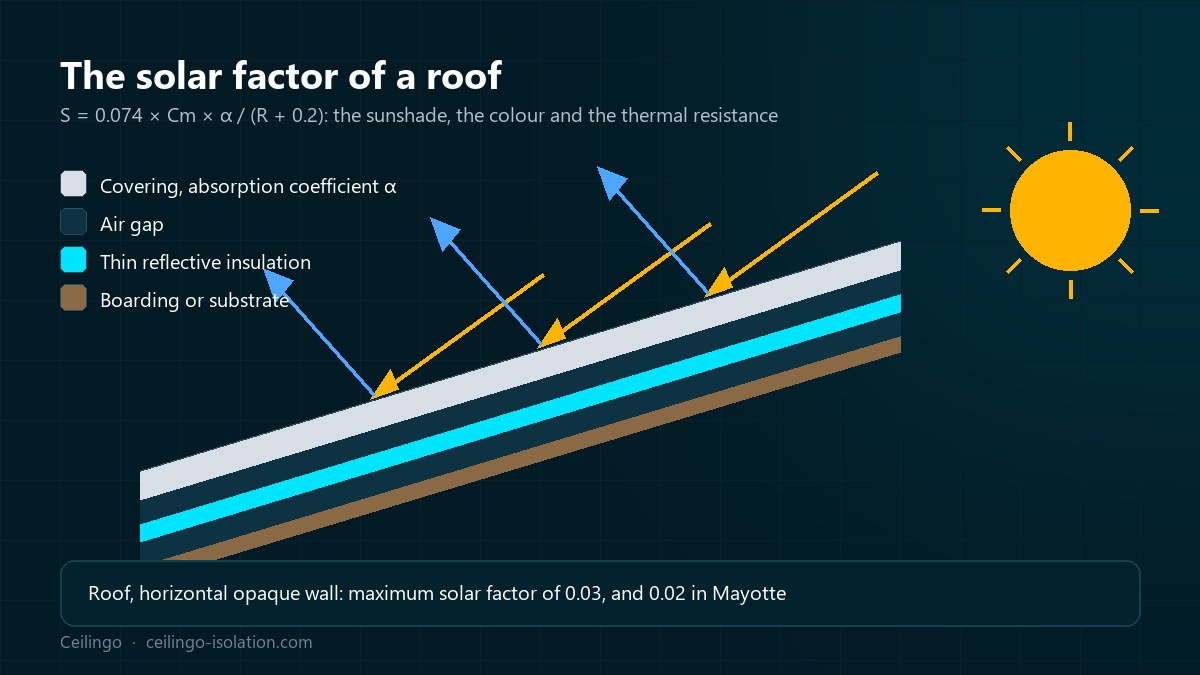
The solar factor of an opaque wall is calculated with a simple formula, given in annex III of the thermal order:
S = 0.074 × Cm × α / (R + 0.2)
Three levers, and a single denominator:
- Cm, the sunshade coefficient, when the wall is protected by an over-roof or an overhang;
- α, the solar absorption coefficient of the outer face, in other words the colour;
- R, the thermal resistance of the wall, insulation included.
The formula shows why an insulant alone does not do everything: R sits in the denominator, so each square metre-kelvin per watt gained has less and less effect, whereas α multiplies the result. Halving the absorption halves the solar factor.
A useful detail: where a wall is protected by a ventilated sunshade, it is the colour of the sunshade that gives α, and the thermal resistances of the sunshade and of the ventilated air gap are not counted in R.
The absorption coefficient: colour, but not just any way
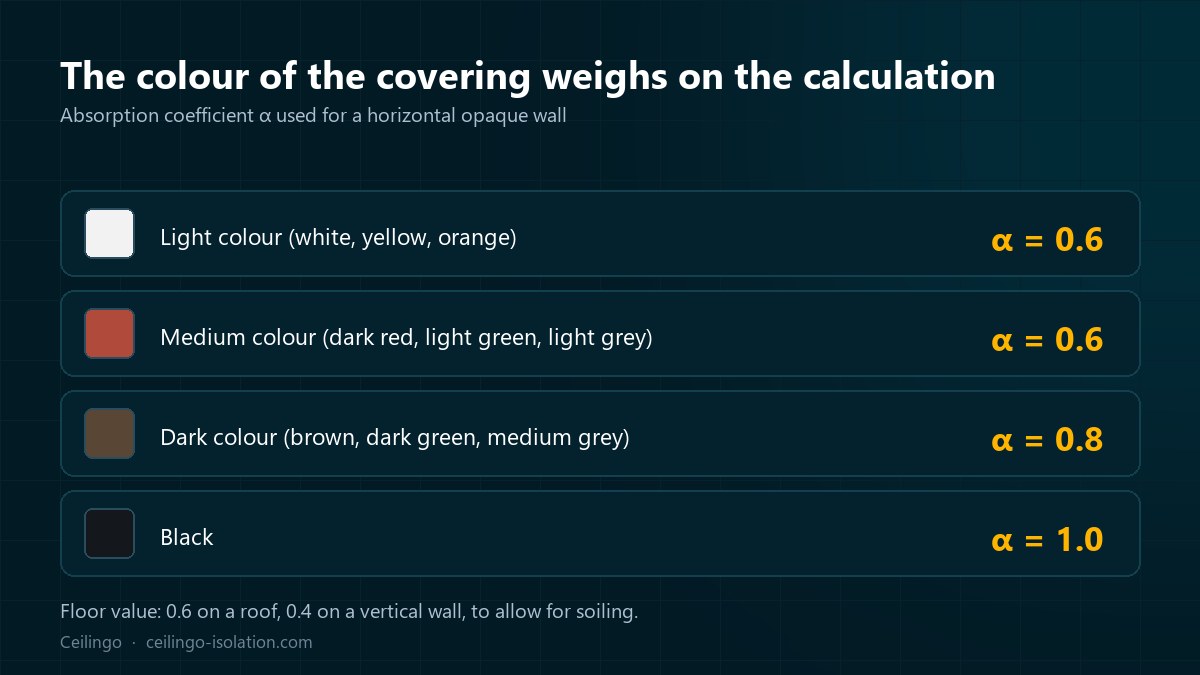
Annex III of the order sorts colours into four families and gives each a coefficient:
- light colour, white, yellow, orange: 0.6 on a horizontal wall, 0.4 on a vertical wall;
- medium colour, dark red, light green, light blue, light grey: 0.6;
- dark colour, brown, dark green, bright blue, medium grey: 0.8;
- black: 1.0.
In the simplified method, a light horizontal covering is therefore taken conventionally at α = 0.6, and a light vertical wall at 0.4: these floor values allow for soiling and for light colours fading. Values declared by a manufacturer may be used under the conditions set out in the application guidance, without going below those floors. A green roof is taken at 0.6.
The practical consequence: a laboratory calculation carried out with α = 0.4 describes a test, not a regulatory roof. For a roof file, it is 0.6 that applies to a light covering, and more if the covering is dark.
What the laboratory calculated on R'BULL Pro 13
In its document DEC/4, dated 10 February 2026, the LNE calculated the solar factor of two roof assemblies including an R'BULL Pro 13, under a white steel covering with an absorption coefficient of 0.4:
- white steel covering, 20 mm counter-battens, slightly ventilated 20 mm air gap, R'BULL Pro 13, 12 mm boarding: S = 0.029;
- the same assembly, completed with 20 mm battens, an unventilated air gap and a 13 mm plasterboard: S = 0.018.
These values cannot be separated from the configuration calculated: the covering, its air gaps, their thickness and their ventilation. The calculations document the performance of two roof assemblies including R'BULL Pro 13; they do not compare an identical roof without the product and therefore do not make it possible to isolate its contribution from the rest of the assembly.
Careful: these two values were calculated with α = 0.4. They are therefore not enough to conclude that a roof complies with the regulation where the applicable method uses α = 0.6. The solar factor is recalculated for the actual configuration on site.
That is precisely the point of the formula: the same product gives different results depending on the covering and the number of air gaps. The assembly counts as much as the product.
Overseas grants speak two languages
Grant schemes fall into two families, and you need to know which one you are aiming at before designing the roof.
The sheets based on thermal resistance:
- BAR-EN-106, housing, unconverted lofts and sloping roofs: R ≥ 1.5 m².K/W;
- BAR-EN-107, housing, walls: R ≥ 0.5 m².K/W, with a higher grant from 1.2;
- BAT-EN-106, commercial buildings, lofts, sloping roofs and flat roofs: R ≥ 1.2 m².K/W;
- BAT-EN-108, commercial buildings, walls: R ≥ 1.2 m².K/W.
BAR-EN-106, BAR-EN-107 and BAT-EN-106 explicitly cite standard NF EN ISO 22097 for reflective insulation, and both BAR-EN-106 and BAR-EN-107 expressly provide for several insulants installed one over the other, with the overall R declared. Sheet BAT-EN-108, in the version in force, sets the 1.2 m².K/W threshold without citing any particular assessment standard.
The sheets based on the solar factor: BAR-EN-109 for existing homes, with S ≤ 0.03 in Guadeloupe, Martinique, French Guiana and La Réunion, S ≤ 0.02 in Mayotte; BAT-EN-109 for existing or new commercial buildings up to 10,000 m², with S ≤ 0.03, new offices and shops in Martinique and Guadeloupe being excluded.
Alongside the CEE scheme, the Anah guide to financial aid in overseas France, September 2026 edition, lists the Agir Plus grants from EDF and HODARI in Mayotte: from €12 to €35/m² for roof insulation depending on the territory and on income, a roof insulation pack combining a solar factor below 0.03 with insulation of 1.5 m².K/W, and, under MaPrimeRénov' in France, solar protection of the roof at €25, €20 or €15/m², ventilated over-roofs and ventilated cladding.
The calculation note, the key document in the file
Sheet BAR-EN-109 distinguishes two cases: a roof system that delivers the required solar factor on its own, and a composition of separate elements. Where the operation is justified as a composition of separate elements, the sheet calls precisely for:
- the list of the elements making up the roof and their technical characteristics, colour or absorption coefficient, thermal resistance, emissivity;
- the solar factor of the system installed;
- the roof area covered by the arrangement;
- and, the key document, a dated and signed calculation note by the professional or by a design office, setting out the solar factor calculation according to the rules of the territory or a recognised method, for example Mayénergie or Batipays.
Applying reflective paint to an existing roof is not eligible under this sheet. As for the qualification of the company, it depends on the scheme: for MaPrimeRénov' solar protection, the Anah guide states that the RGE qualification used in France is not compulsory, whereas sheet BAR-EN-109 requires, where the beneficiary is a private individual, a professional holding the quality sign it provides for.
In other words: the file is not won with a product data sheet, it is won with a calculation for the works. Our test reports supply the inputs for that calculation, measured emissivity, thermal resistance, solar factors of known configurations.
What the texts say
- Order of 17 April 2009, RTAA DOM: maximum solar factor of walls, annex III and absorption coefficients
- Thermal regulation of French Guiana, 2020: rules specific to the territory
- Thermal regulation of Martinique, 2013: rules specific to the territory
- Standardised energy saving operation sheets (CEE), France: BAR-EN-106, BAR-EN-107, BAR-EN-109, BAT-EN-106, BAT-EN-108 and BAT-EN-109, versions applicable in September 2026; insulation sheets BAR-EN-106, BAR-EN-107 and BAT-EN-106 are announced as repealed on 1 May 2027
- Anah guide to financial aid in overseas France, September 2026: Agir Plus, HODARI, roof insulation pack and solar protection
- LNE report P254377, document DEC/4 of 10 February 2026: solar factors calculated on two roof assemblies, under a white steel covering with α = 0.4
Frequently asked questions
Why is thermal resistance not enough in overseas France?
Because the regulation targets the heat that comes in by radiation. In the solar factor formula, thermal resistance sits in the denominator, with an effect that fades quickly, whereas the colour of the covering multiplies the result directly. A very well insulated but dark roof can stay above the threshold.
Which absorption coefficient applies to a white steel covering?
0.6 on a roof. The text sets this floor value for horizontal walls, even where the new product performs better, to allow for soiling and fading. On a vertical wall, the floor is 0.4.
Is R'BULL Pro 13 enough on its own for an overseas grant?
That depends on the sheet aimed at and on the actual works. BAR-EN-106 and BAR-EN-107 explicitly provide for several insulants installed one over the other and for the overall R to be declared. BAT-EN-106 requires 1.2 m².K/W and recognises standard NF EN ISO 22097. The sheets based on the solar factor call instead for the roof or the system actually installed to be justified. In every case, it is the installed works that are examined, not the product data sheet.
Which grants for a commercial building?
The BAT sheets: BAT-EN-106 for the insulation of lofts, sloping roofs and flat roofs, with a threshold of 1.2 m².K/W, BAT-EN-108 for walls, and BAT-EN-109 for reducing solar gains, limited to buildings of at most 10,000 m². R'BULL Pro 13 is installed in overseas France under sheet BAT-EN-106.
Who writes the calculation note?
The professional carrying out the works or a design office. It is dated and signed, and sets out the solar factor calculation according to the rules applicable in the territory or a recognised method. Our technical support supplies the input data and checks that the proposed assembly holds together.