
Livestock buildings and warehouses: the heat comes from radiation, not from the air
At the end of June 2026, the fresh egg shelf emptied in shops that had done nothing unusual. Upstream, buildings had lost their animals in three days. The heat had not come in through the door, it had come down from the roof.
Key points in 30 seconds
- At the end of June 2026, a single heatwave cost 700,000 laying hens, 1 to 1.5 % of the French flock, and 2.5 to 3 million broilers. The industry pointed to the same culprit: the age of the building, its insulation and its ventilation.
- Mortality is only the visible part. At a constant 32 °C, egg laying falls by 15 to 30 %, and egg weight drops by 0.4 to 1 g for every degree above 25 °C. A dairy cow loses 2 to more than 4 kg of milk a day when the temperature rises from 26 to 33 °C.
- Hot air and radiant heat are two different things. In a car parked in the sun, the cabin air was measured at 47 °C and the dashboard at 69 °C, at the same moment. Radiation heats matter, not air.
- Under a metal roof, it is this radiation that comes down onto the litter, the animals and the pallets. A low-emissivity underside cuts it off: ε = 0.053 measured on R'BULL Pro 13 by the LNE, a value declared as 0.05 under annex D of EN ISO 22097:2023.
- The problem is not a French one. The Lancet Planetary Health puts the worldwide losses in cattle production caused by heat at 39.94 billion dollars a year by the end of the century, with tropical regions hit far harder than temperate ones.
- Infrared thermometer reading under a shed roof: 54.6 °C on the underside of the metal sheet, 29.2 °C on the face of R'BULL Pro 13 a few centimetres below. Twenty-five degrees between the two surfaces.
- The best heat to get rid of may well be the heat you never let in. R'BULL Pro 13 is fitted to the roof underside, without removing the covering, as a complement to the existing insulation and ventilation.
An empty shelf, and 700,000 missing hens

This photo has nothing to do with a supply glitch. At the end of June 2026, a heatwave pushed temperatures above 40 °C in regions of France unused to it, Brittany and Pays de la Loire first among them. The industry’s assessment is blunt: 700,000 laying hens lost, 1 to 1.5 % of the French flock according to the CNPO, and 2.5 to 3 million broilers according to Anvol. In a matter of days.
What the professionals said next is worth reading twice. Old buildings could not absorb the peaks; recent ones, better designed for insulation and ventilation, held. Natural ventilation, common in free-range and label production, paid the highest price. In other words, the difference between a farm that lost its flock and a farm that kept it did not come down to the weather, which was the same for everyone. It came down to the building.
A farmer does not only lose animals. They lose a whole flock, the cash that came with it, sometimes several weeks of production, and they spend the heatwave removing dead animals instead of doing their job. The retailer discovers an empty shelf and puts up an apology notice. In between, nobody has a solution on the day.
What heat takes, even before it kills
Mortality makes the headlines, but it is the end of a list. Before it comes to that, heat takes production away every day, quietly, and that loss never shows up in a rendering truck.
In laying hens. Researchers from INRAE and ITAVI pointed it out this summer: at a constant 32 °C, against the usual 22 °C, egg production falls by 15 to 30 %. Egg weight drops by 0.4 to 1 gram per degree above 25 °C, and shell quality deteriorates within the first days of exposure. A hen’s core temperature is around 41 °C: beyond 42 °C, prolonged exposure becomes lethal. The margin is narrow, and it closes from the top.
In broilers. The benchmarks of the ClimatBat network of the French chambers of agriculture put the thermoneutral zone of a growing bird at around 18 to 24 °C. Feed intake falls as soon as the indoor temperature passes 23 °C. Beyond 25 °C, the bird can only shed heat by evaporation, that is by panting, and the risk is assessed on a temperature-humidity index, severe from 73 and very severe beyond 78.
In dairy cows. Their thermoneutral zone lies between 2 and 15 °C, which often comes as a surprise. The index value of 68, the first stress threshold, is reached at just 22 °C and 50 % humidity, an ordinary summer day in mainland France. The review carried out by the French Livestock Institute (Idele) for the dairy interprofession Cniel puts figures on what follows: 270 to 590 grams of milk per index point, that is 2 to more than 4 kg per cow per day when the temperature rises from 26 to 33 °C. Under severe stress, breathing rises to 150 breaths a minute.
| Production | What gives way first | Measured order of magnitude | Source |
|---|---|---|---|
| Laying hens | Laying rate, egg weight and shell | Laying 15 to 30 % lower at a constant 32 °C; eggs 0.4 to 1 g lighter per degree above 25 °C | INRAE and ITAVI, 2026 |
| Broilers | Feed intake, then mortality | Feed intake falls from 23 °C; temperature-humidity index very severe beyond 78 | ClimatBat |
| Dairy cows | Milk yield and composition | 270 to 590 g of milk per index point; 2 to more than 4 kg a day from 26 to 33 °C | Idele for Cniel, 2021 |
| All production types | Fertility, health, cash flow | 700,000 laying hens and 2.5 to 3 million broilers in the June 2026 heatwave alone | CNPO and Anvol |
These figures describe very different buildings. A broiler house works on the floor, on litter, with a lighting programme, finely tuned ventilation and strict biosecurity. A laying house is organised around egg collection: dark nests with a sloping floor, belts that carry the egg to the grading room, multi-tier aviaries with perches, feeders and drinkers, and, in free-range and organic systems, pop holes opening onto a winter garden and then the outdoor range. A dairy barn is nothing like either. What they share is above the animals: the roof.
And the farmer, inside that building?
They work there. In France, decree no. 2025-482 of 27 May 2025 wrote it into the labour code in black and white: since 1 July 2025, employers must assess the risk linked to episodes of intense heat indoors as well as outdoors, record the measures in the risk assessment document and provide at least three litres of cool water per employee per day where there is no running water. A building whose roof radiates heat is not only a production problem. It is a workplace.
Do not confuse hot air with radiant heat
Here is the point almost everyone misses, and it changes the diagnosis completely.
You know the scene. A car left in the sun, door open: the air is stifling but breathable, and yet the steering wheel burns your hands and the dashboard is impossible to touch. This is not an impression. Researchers from Arizona State University and the University of California San Diego measured it, over three summer days in Tempe.
| After one hour | Car in the sun | Car in the shade |
|---|---|---|
| Cabin air | 47 °C | 38 °C |
| Dashboard | 69 °C | 48 °C |
| Steering wheel | 53 °C | 42 °C |
| Seats | 51 °C | 41 °C |
Look at the first column. Between the air an occupant breathes and the dashboard they touch, there are 22 degrees of difference, in the same space, at the same moment. Now look at the second: in the shade, the dashboard is only 10 degrees above the air. The whole difference between the two columns is radiation.
Radiation heats matter, not air. A thermometer hanging in the middle of a building measures the air, and it can show a reassuring reading while the litter, the animals’ backs, the pallets and the staff’s necks are receiving far more. That is why a poultry house can read 30 °C on the controller screen and still have its birds panting.
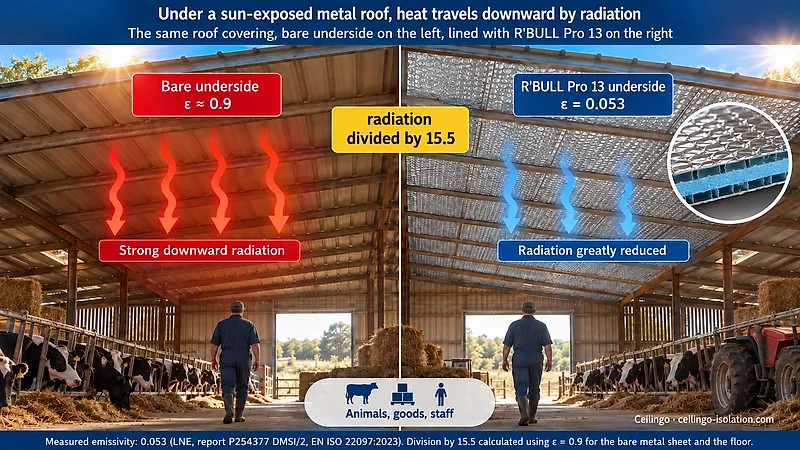
A metal roof does exactly what the dashboard does, on a larger scale. The order of magnitude is easy to work out: the surface overheating is roughly the absorbed solar flux divided by the external surface heat transfer coefficient, which EN ISO 6946 sets conventionally at 25 W/(m²·K). With 1,000 W/m² at the zenith, that gives:
| Roof covering | Absorption coefficient | Calculated surface overheating |
|---|---|---|
| White sheeting, the value used by the LNE in its calculations | 0.4 | +16 K above air temperature |
| Minimum value imposed on horizontal walls by the French overseas RTAA DOM | 0.6 | +24 K above air temperature |
| Dark or weathered covering | 0.9 | +36 K above air temperature |
These three lines are calculations, not measurements, and they ignore both wind and radiation to the sky. They are still enough: at 32 °C in the shade, a dark roof covering works at around 68 °C, its underside included since the sheet is thin. That underside radiates towards everything beneath it, and radiation crosses the air gap without caring whether it is ventilated. This is where ventilation reaches its limit: it moves air, it does not move radiation.
Radiative exchange between two parallel surfaces depends on the emissivity of both, through a mutual emissivity factor equal to 1 / (1/ε₁ + 1/ε₂ - 1). Between coated sheeting and a building floor, two surfaces around 0.9, that factor comes to 0.818. Replace the first with an underside at 0.053 and it drops to 0.053 as well: as soon as one of the two surfaces emits little, it is the one in charge, and the same temperature difference transmits only a fifteenth of the flux. The principle is set out on our page R'BULL technology.
The same problem, from Brittany to India
None of the above is peculiar to France. France accounts for only 10.6 % of European chicken production, behind Poland (19.5 %) and Spain (12.3 %), and the June 2026 heatwave swept across the continent: the empty shelf in the first photo could have been in any of those countries.
In the United States, the bill was worked out long ago, and it is annual, not exceptional. A study in the Journal of Dairy Science puts the losses of American livestock farming due to heat stress at 1.69 to 2.36 billion dollars a year, across all animals, with dairy bearing the largest share. Lower growth, laying, milk yield and fertility, plus mortality, added up year after year.
On a global scale, a model published in The Lancet Planetary Health in March 2022 projects, for cattle alone and by the end of the century, production losses of 39.94 billion dollars a year under a high-emission scenario, 9.8 % of the value of the meat and milk produced in 2005, and 14.89 billion under a low scenario. Two results stand out: cattle and dairy production in the United States would fall by 6.8 %, India would lose more than 45 % of its dairy production, and tropical regions take a far heavier hit than temperate ones.
| Scale | What is measured or projected | Source |
|---|---|---|
| France, June 2026 | 700,000 laying hens and 2.5 to 3 million broilers, in a matter of days | CNPO and Anvol |
| United States, every year | 1.69 to 2.36 billion dollars for livestock farming as a whole | Journal of Dairy Science, 2003 |
| World, by the end of the century | 39.94 billion dollars a year for cattle alone, 9.8 % of the value produced | The Lancet Planetary Health, 2022 |
That is exactly the map of our shipments. In the French West Indies, in French Guiana, and everywhere between the tropics, heat is not a three-day episode in June: it is the normal condition of the year. A building there spends its whole life under the radiation that mainland France only sees for a few weeks.
Regulations follow, each in its own way. The French overseas departments apply the RTAA DOM and its solar factor. The Indian state of Telangana has required reflective materials since April 2023, through its cool roof policy, on public and commercial buildings and on residential plots of more than 600 square yards, with a target of 300 km² of treated roofs. An honest clarification is needed: these rules target the outer face of the roof covering, which they want light-coloured and highly emissive towards the sky, whereas a thin reflective insulation works on the inner face, which it wants to be low-emissive towards the building. The two add up, at the two ends of the same roof.
What has already been tried, and why the load keeps coming back
Farmers have not sat and waited. They have ventilated harder, installed misting, sprinkled roofs, shifted working and feeding times, reduced stocking density, adjusted rations. After June 2026, a cooperative in western France set out to equip 170 farms with fans, at around 1,500 € each, 70 % funded. An enriched feed gains about 2.9 performance points over the stress period. All of this works, all of it is useful, and none of it should be dropped.
Look, though, at where each of these measures acts. Ventilation, misting, feed, lower stocking density all come in afterwards, once the heat is inside. They compensate. They cost electricity, water, noise, labour, and they cost all the more as the load to be compensated grows. On the day it passes 40 °C outside, the fresh air being blown in is also at 40 °C: ventilation no longer cools, it just stirs.
That leaves a question rarely asked: what does doing nothing cost? A lost flock, several weeks of poor laying, milk not produced every summer day, refrigeration running for nothing, staff slowed down, and the following year the same again, a little earlier and a little longer. Against that, a one-off intervention on the roof at least deserves to be costed.
The best heat to get rid of may well be the heat you never let in.
The thermal shield under the roof
We are talking here about a solution that can, depending on the roof configuration, complement your construction choices where summer comfort is an identified issue. Not replace them.
That is the logic behind R'BULL Pro 13: a reflective thermal shield under the roof, designed to limit part of the radiant heat gains, as a complement to the existing insulation and ventilation. It does not blow air, it uses no energy, it needs no adjustment. It presents the building with a face that emits little, and the radiation coming down from the sheet no longer finds a way through.
What it does better than an ordinary underside comes down to one figure. The LNE measured its emissivity at 0.053 in its report P254377 DMSI/2, under annex D of EN ISO 22097:2023, the same annex that requires any value below that threshold to be declared as 0.05. Where a coated sheet sends most of what it receives back downwards, this face sends back only a fraction. The solution is also backed by laboratory tests, including a B-s1, d0 reaction to fire classification.
It remains to be seen what this gives under a real roof. An infrared thermometer, a shed, two readings a few centimetres apart: 54.6 °C on the underside of the sheet, 29.2 °C on the face of the R'BULL Pro 13 fitted beneath it.
This figure must be read for what it is: a one-off reading, taken on a given day under a given roof, not a standardised test. It still shows the only thing that matters for what lies below. It is no longer a surface at 54.6 °C radiating onto the animals, the pallets and the staff, but a surface at 29.2 °C. Twenty-five degrees less on the face that looks down at them. That is where the fight against heatwaves is won inside a building, and it is also what makes low-cost cooling possible, by reducing reliance on air conditioning.
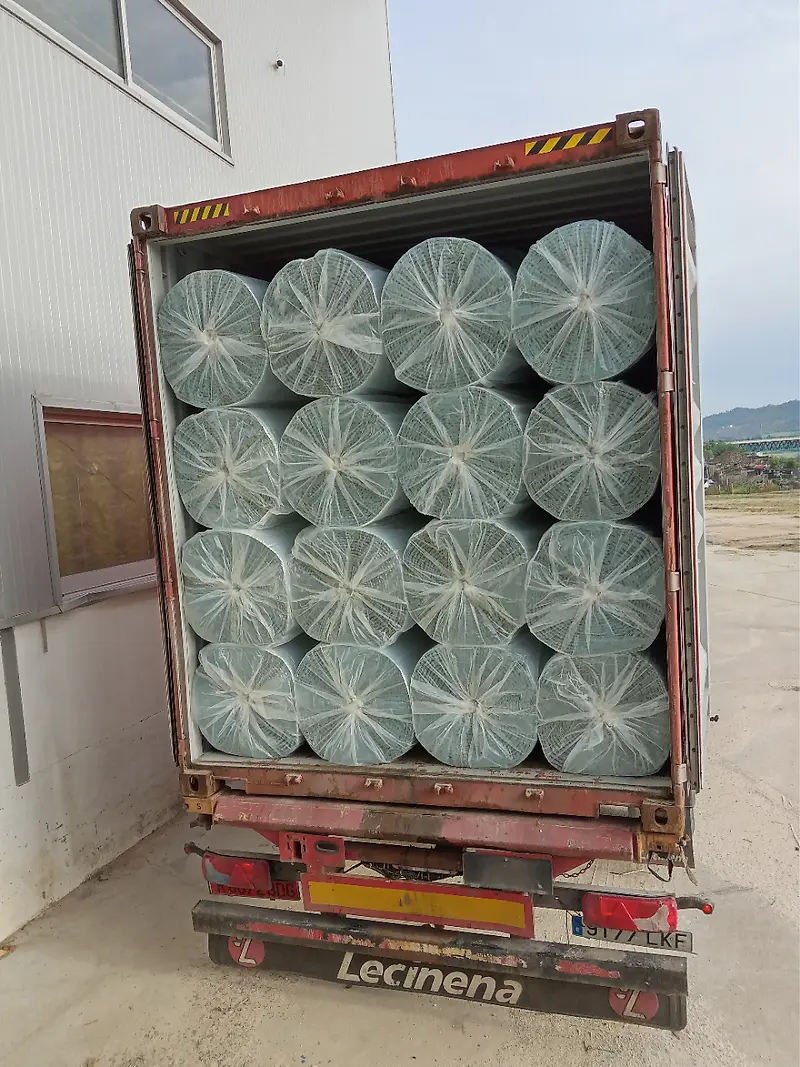
Three practical arguments add to the figure, and they are often what decides on a building in operation: thirteen millimetres steal no usable height under a truss; a roll is handled by two people, with no machinery; fitting is done from below, without removing the covering. On an island destination, where freight is billed by volume, a forty-foot container carries about 4,000 m² of Pro 13. That is a distribution argument as much as a technical one.
What can be claimed, and on what basis, is worth setting out in black and white.
| Quantity | Value | What it characterises | Source |
|---|---|---|---|
| Thermal resistance of the insulation alone | 0.29 m²K/W | The product, measured with a heat flow meter | KTU 080-1 SF/25 R |
| Resistance with two 20 mm air gaps | 1.60 m²K/W | One precise vertical assembly, gaps calculated, not a roof | KTU, EN 16863 annex D |
| Emissivity | 0.053 measured, 0.05 declared | The reflective face of the product | LNE P254377 DMSI/2 |
| Solar factor under white sheeting | 0.029 or 0.018 | Two complete roof build-ups, with α = 0.4 | LNE P254377 DEC/4 |
| Fire reaction | B-s1, d0 | The product | AITEX 2025AN2499 |
A clarification that matters, and one we prefer to give ourselves: none of these values makes a building compliant with anything. Directive 2007/43/EC, for example, requires the indoor temperature of a poultry house not to exceed the outdoor temperature measured in the shade by more than 3 °C once that temperature passes 30 °C, for farms above 33 kg/m². That requirement applies to the building, ventilation included. What the shield removes is the radiant load, the largest share on a clear day. The rest still depends on ventilation and management.
Fitting without stopping production
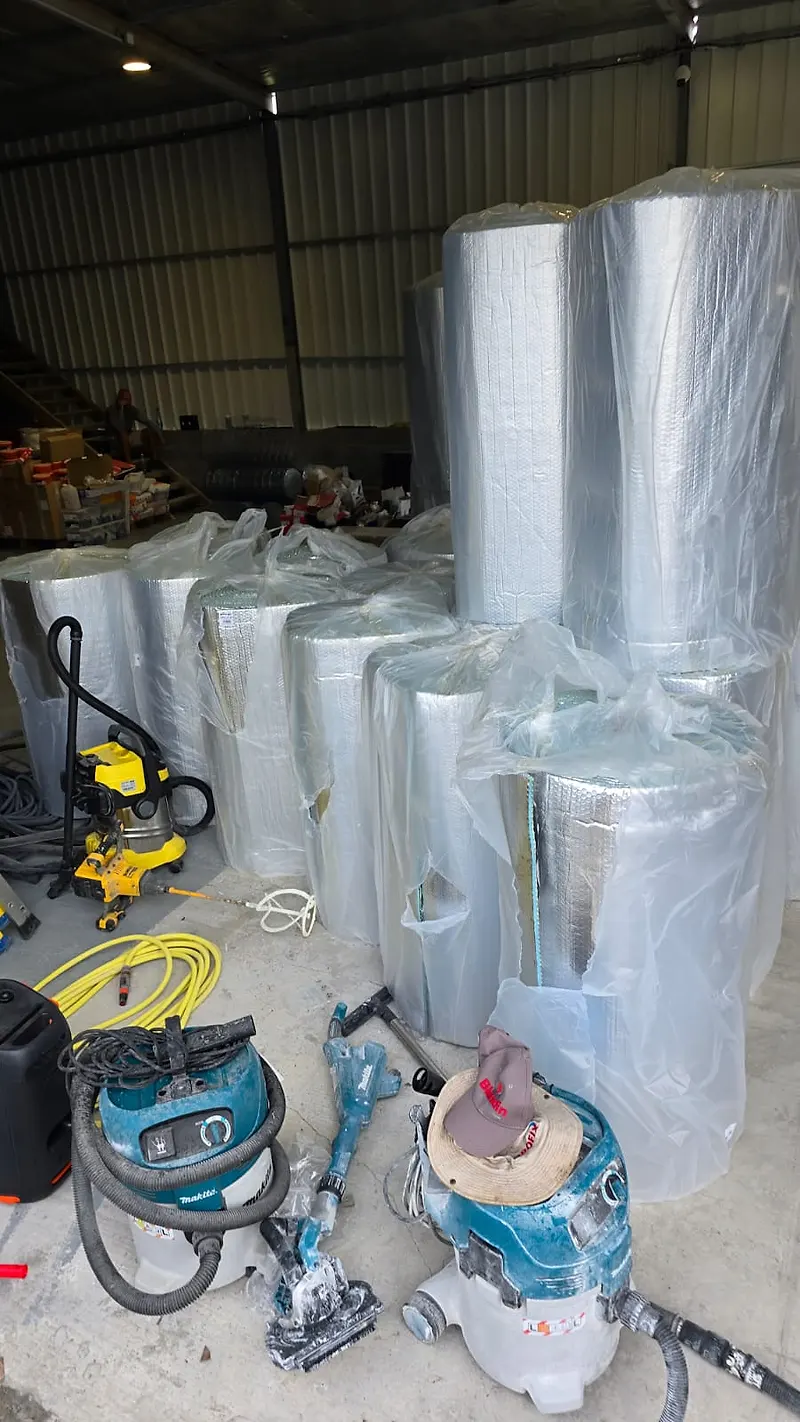
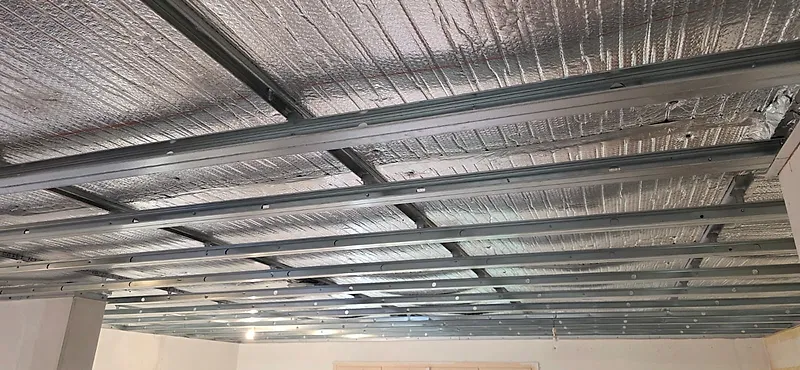
Fitting to the roof underside is the most common configuration on these sites, and the simplest: the insulation is fixed under the roof structure, without removing the covering and without stopping the building’s activity more than necessary. The sheets are laid perpendicular to the purlins, butted edge to edge, and fixed with a pneumatic nailer to the roof structure.
Two points make all the difference between a job that delivers and a disappointing one. The first is the air gap: reflective insulation pressed against the sheet loses most of its value, since there is no longer a space for the radiation to cross. The second is continuity, at the verges, at the ridges, around rooflights and duct penetrations, wherever an opening locally brings back the conditions of a bare underside.
The mistakes that cost the gain
- fitting the insulation against the covering, with no air gap on at least one side;
- leaving sheets apart at the verges, where nobody ever looks;
- forgetting technical penetrations, extractors, downpipes, cable trays;
- expecting the insulation to meet an indoor climate requirement on its own, when ventilation is part of it too;
- reusing a thermal resistance obtained with vertical air gaps to justify a roof, when the configuration is not the same.
In French buildings open to the public, there is an extra constraint. Article AM 8 of the French fire safety regulation covers any insulation thicker than 5 mm and leaves two routes, a classification of at least A2-s2, d0 or a thermal screen on the inner fire side. Since R'BULL Pro 13 is classified B-s1, d0, it falls under the second route, as explained in our article on thin insulation in public buildings.
Livestock buildings and cities turning into heat boilers
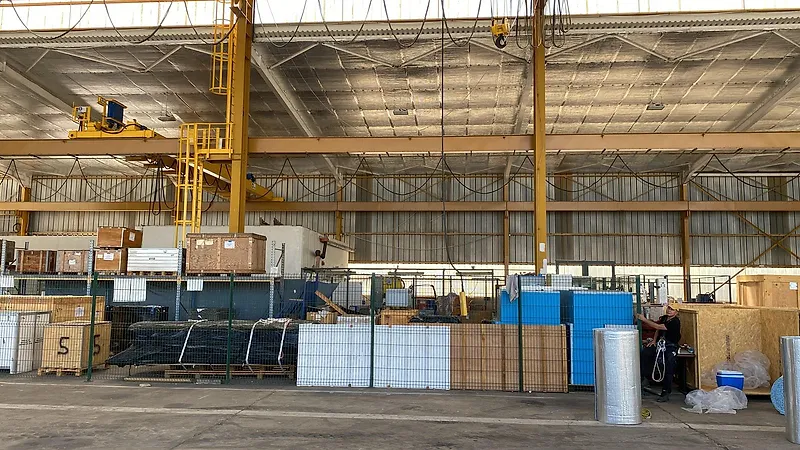
The mechanism does not care about sectors. In a logistics warehouse, radiation coming down from the roof builds up high and falls back onto the racking: it damages whatever is sensitive to temperature, it wears down forklift drivers, and it keeps refrigeration units running that were never meant to make up for a roof. In a retail outlet, it is paid for in air conditioning. In a research centre or an instrument room, it is paid for in measurement drift. The same containers leave for all of these sites.
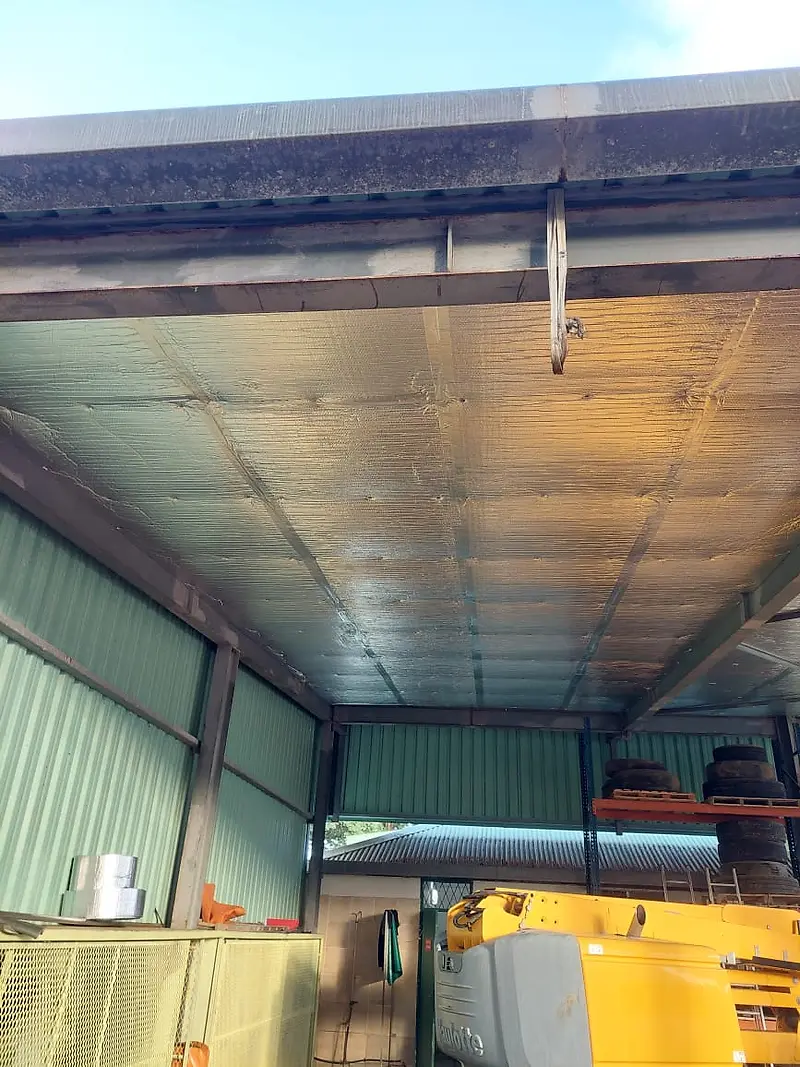
In the tropics, the case has already been made to the authorities: in the French overseas departments, the RTAA DOM sets a solar factor of no more than 0.03 for roofs, and the two build-ups calculated by the LNE with an R'BULL Pro 13 under white sheeting meet that threshold. The calculation is redone for the roof actually built, as explained in our article insulating an overseas roof.
That is the thread Ceilingo follows internationally: insulation designed against radiant heat gains, to limit the impact of heatwaves and reduce the boiler effect in homes and cities. The cycle is well known. Heat gets in, people switch on the air conditioning, the air conditioning dumps its heat outside, the street warms up, people use even more air conditioning, and some cities now exceed 50 °C. Every watt of radiation stopped at the roof is a watt no machine will have to dump into the street.
On a livestock building as on a warehouse, the right way to start is always the same: describe the existing roof, say what is underneath and at what temperature it has to stay. Our technical support reviews the proposed build-up and supplies the input data for the calculation; the reports quoted here can be read in full on the test reports page, the complete range is in the reflective insulation section, and new market projects go through our distributors.
Where these figures come from
- Heatwave in poultry farms, Réussir Volailles, 9 July 2026: 700,000 laying hens lost, 1 to 1.5 % of the French flock according to the CNPO, and 2.5 to 3 million broilers according to Anvol; the age of the building, its insulation and its ventilation made the difference
- Heatwave: hens lay fewer eggs, and smaller ones, INRAE and ITAVI, July 2026: laying down 15 to 30 % at a constant 32 °C against 22 °C, egg weight down 0.4 to 1 g per degree above 25 °C, shell quality deteriorating within the first days
- Impacts of heat stress on dairy cows, French Livestock Institute (Idele) for Cniel, 2021: 270 to 590 g of milk lost per temperature-humidity index point, that is 2 to more than 4 kg a day when the temperature rises from 26 to 33 °C
- ClimatBat, network of the French chambers of agriculture: thermoneutral zone of the growing broiler from 18 to 24 °C, drop in feed intake beyond 23 °C, temperature-humidity index; dairy cow thermoneutral from 2 to 15 °C, index of 68 reached at 22 °C and 50 % humidity
- Vanos et al., Temperature journal, 2018, vehicles parked in the sun and in the shade: after one hour in the sun, cabin air 47 °C, dashboard 69 °C, steering wheel 53 °C, seats 51 °C; in the shade, air 38 °C and dashboard 48 °C
- Europe’s leading chicken and turkey producers, Eurostat data compiled by Anvol: European chicken production: Poland 19.5 %, Spain 12.3 %, France 10.6 %
- St-Pierre, Cobanov and Schnitkey, Journal of Dairy Science, 2003, economic losses in US livestock farming: 1.69 to 2.36 billion dollars a year for US livestock farming as a whole, with dairy bearing the largest share
- Thornton, Nelson, Mayberry and Herrero, The Lancet Planetary Health, March 2022, heat stress and global cattle production: 39.94 billion dollars of annual losses by the end of the century under a high-emission scenario, 9.8 % of the value produced in 2005, and 14.89 billion under a low scenario; US production down 6.8 %, India beyond 45 %; tropical regions hit far harder than temperate ones
- Cool Roof Policy of the State of Telangana, India, 2023-2028: reflective materials made mandatory on public and commercial buildings and on residential plots of more than 600 square yards, target of 300 km² of treated roofs
- Directive 2007/43/EC of 28 June 2007 on the protection of chickens kept for meat production: stocking density of 33 kg/m², 39 kg/m² subject to annex II; annex II point 3: indoor-outdoor difference limited to 3 °C above 30 °C, 20 ppm NH3, 3,000 ppm CO2
- French decree no. 2025-482 of 27 May 2025 on protecting workers against heat-related risks: risk assessment indoors as well as outdoors since 1 July 2025, measures recorded in the risk assessment document, three litres of cool water per employee per day where there is no running water
- RTAA DOM: solar factor of no more than 0.03 for horizontal opaque walls in the French overseas departments, formula and absorption coefficients of annex III
- Standard EN ISO 22097:2023: measurement of the thermal resistance and emissivity of reflective products; annex D requires any measured emissivity below 0.05 to be declared as 0.05
- Reports KTU 080-1 SF/25 R, LNE P254377 DMSI/2 and DEC/4, AITEX 2025AN2499: thermal resistance, emissivity, solar factor and reaction to fire of R'BULL Pro 13
Frequently asked questions
How much does a heatwave really cost a livestock farm?
Mortality is the visible part: 700,000 laying hens and 2.5 to 3 million broilers in the late June 2026 heatwave alone. The invisible part often weighs more on the year's accounts: 15 to 30 % less laying at a constant 32 °C, eggs 0.4 to 1 g lighter per degree above 25 °C, and 2 to more than 4 kg of milk per cow per day. Add to that poorer fertility, carcass disposal costs and time lost.
Isn't ventilation enough?
It is essential and nothing replaces it, but it moves air. Radiation coming down from a hot roof is not carried by the air: it crosses the air gap, ventilated or not, and heats surfaces directly. On a day when it is 40 °C outside, the fresh air blown in is also at 40 °C. Treating the underside removes the load upstream; ventilation handles what is left.
Why talk about radiation rather than temperature?
Because a thermometer measures the air, not what the animals receive. In a car in the sun, the cabin was measured at 47 °C and the dashboard at 69 °C, at the same moment. Under a metal roof the same thing happens on the scale of a building: the controller can show an acceptable reading while the litter and the animals’ backs are receiving far more.
Can it be fitted under an existing roof without stopping production?
Yes, it is the most common configuration. The insulation is fixed under the roof structure, in butted sheets perpendicular to the purlins, fixed with a powder-actuated tool to the roof’s load-bearing structure, without removing the covering. The one condition not to overlook is to keep an air gap on at least one side: pressed against the sheet, reflective insulation loses most of its effect.
How many square metres fit in a forty-foot container?
Around 4,000 m² of R'BULL Pro 13 in standard stacking. On a distant or island destination, where freight is billed by volume, that figure sets the delivered cost per square metre.
Can a large retail store use this insulation?
Yes, subject to article AM 8 of the French fire safety regulation for buildings open to the public. R'BULL Pro 13 is classified B-s1, d0 by AITEX, so it does not reach the A2-s2, d0 level that exempts a screen; it is fitted behind a thermal screen on the inner fire side, plasterboard for example. The thicknesses accepted without justification and the compartmenting of air gaps are set out in our article thin insulation in public buildings.