
Soundproofing a wall: the complete wall is what counts
A wall that lets the neighbour's television through is not necessarily badly built. More often than not it is simply too light, or bypassed by sound travelling elsewhere. Before choosing a material, it is worth knowing what an acoustic rating measures, and what it applies to.
Key points in 30 seconds
- Regulations do not address a product: in France, for new dwellings, the order of 30 June 1999 requires a DnT,A sound insulation of at least 53 dB between two dwellings, measured on site, once the building is finished.
- Rw is a laboratory rating, obtained where flanking transmission is suppressed. It is never found as such on a building site.
- Airborne noise obeys mass first: doubling the surface mass of a single wall gains around 6 dB. No 20 mm layer provides that mass, and none claims to.
- A thin acoustic insulation works elsewhere: inside the cavity of a double wall, where it damps the resonance that couples the two leaves.
- LNEC measured Rw = 50 dB (-1 ; -5) on a double brick wall 0.29 m thick whose 50 mm cavity contains 20 mm of R'Acoustic 20. That is the performance of this wall, not of the product on its own.
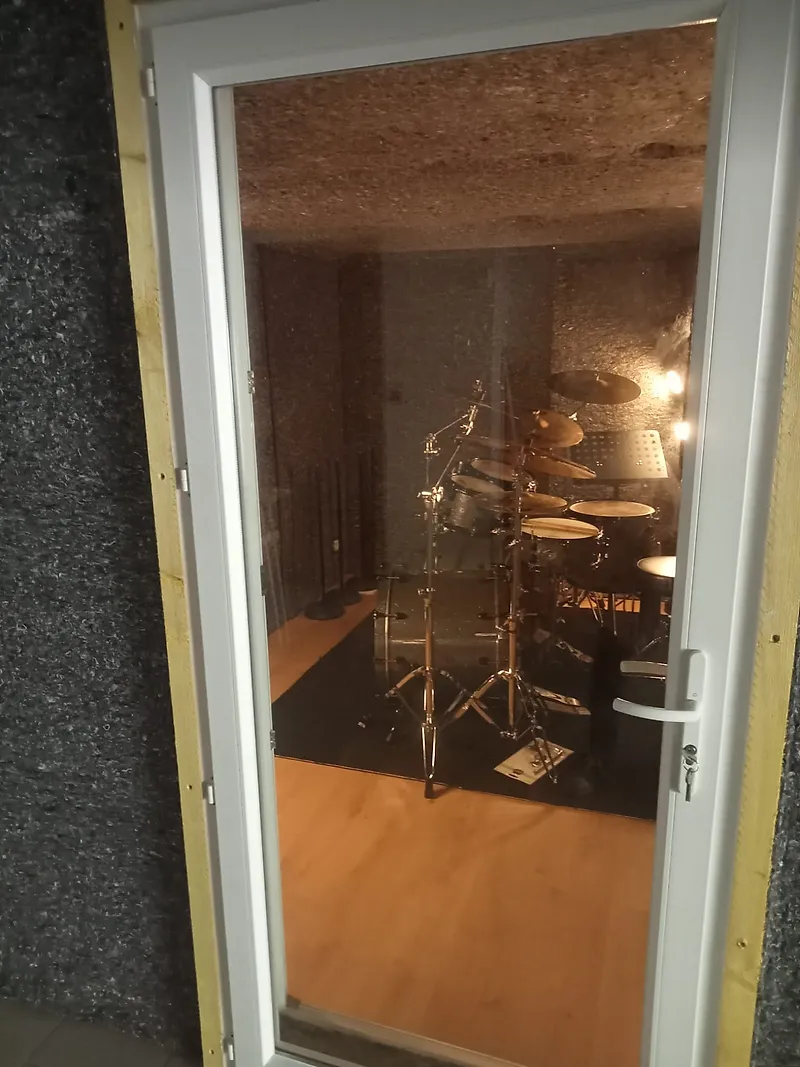
Two kinds of noise, two mechanisms, two remedies
A wall does not react in the same way to everything sent at it. Airborne noise, voices, television, music, traffic, arrives through the air and sets the wall vibrating. Impact noise, footsteps, a dropped object, furniture being moved, enters the structure directly and travels through concrete or timber far beyond the room it came from. Two separate rating standards deal with them, EN ISO 717-1 and EN ISO 717-2, and above all two families of solutions.
Soundproofing a party wall almost always belongs to the first family. The question is therefore not to find a material that absorbs, but to understand why the wall vibrates and how to stop it. An absorber fixed to the inner face improves the acoustics of the room, which is not the same thing as its sound insulation: it makes the room less reverberant, it does not reduce what passes through.
It remains to be seen what a gain is worth. The decibel is logarithmic, and the ear does not follow it linearly.
| Gain achieved | What the ear perceives |
|---|---|
| 3 dB | Half as much sound energy transmitted, a barely noticeable difference |
| 6 dB | A clear gain, the source seems to move away |
| 10 dB | The noise sounds roughly half as loud |
This table explains many disappointments on site. A lining that gains 3 dB has halved the transmitted energy, and the client hears almost the same thing.
What French regulation requires, and of whom
In France, for new residential buildings, the order of 30 June 1999 sets figures. Between a room of one dwelling and a main room of another dwelling, the standardised weighted sound insulation DnT,A must reach at least 53 dB, and 50 dB where the receiving room is a kitchen or a bathroom. The level rises when the emitting room is noisier: 55 dB from a garage, 58 dB from a commercial or industrial space. From a common circulation area separated by a door, the requirement drops to 40 dB.
The same text covers impact noise, with a weighted pressure level L'nT,w of no more than 58 dB in main rooms, and façade insulation, with a DnT,A,tr of at least 30 dB. The order of the same day on how the regulation applies sets out how these ratings are calculated: DnT,A is the sum of DnT,w and the spectrum adaptation term C, DnT,A,tr the sum of DnT,w and Ctr, and the measurement uncertainty allowed during an inspection is 3 decibels.
One point deserves to be stated plainly: none of these values applies to a product. They describe a result obtained on site, in a finished building, with its junctions, its service ducts and its detailing. A material therefore cannot comply with the order; it is the completed work that does or does not.
In renovation work these thresholds are not compulsory. They remain the benchmark everyone uses to judge a result, and the reference we take in our studies.
Rw, RA, RA,tr: three figures for the same wall
In the laboratory, a building element is mounted between two reverberation rooms and measured band by band in accordance with EN ISO 10140-2. EN ISO 717-1 then sums the curve up in a single number, the weighted sound reduction index Rw, together with two spectrum adaptation terms that say how the wall behaves against two different spectra:
- C targets indoor noise, rich in mid and high frequencies: voices, television, household activity;
- Ctr targets urban traffic noise, heavier in the low frequencies.
They are added: RA = Rw + C for indoor noise, RA,tr = Rw + Ctr for traffic noise. A wall quoted at 50 dB (-1 ; -5) is therefore worth 49 dB against the neighbours and 45 dB against a main road. The second figure is the one people forget to read, and it is often the one that decides real comfort.
The measurement standard itself takes care to warn that its results cannot be transferred directly to a building site: the test facility suppresses flanking transmission, whereas a building is full of it. Moving from the laboratory to the completed work calls for a prediction calculation, the one in EN 12354-1, which accounts for the connected walls, the junctions and the volume of the rooms. That is why an Rw of 50 dB is not to be compared with the regulatory threshold of 53 dB: the two figures do not describe the same thing.
The mass law, and the wall where it stops
For a single homogeneous wall, sound reduction follows a robust rule: doubling the surface mass gains around 6 dB, and the same is gained each time the frequency doubles. It explains why a cast concrete wall insulates and why a light drywall partition does not.
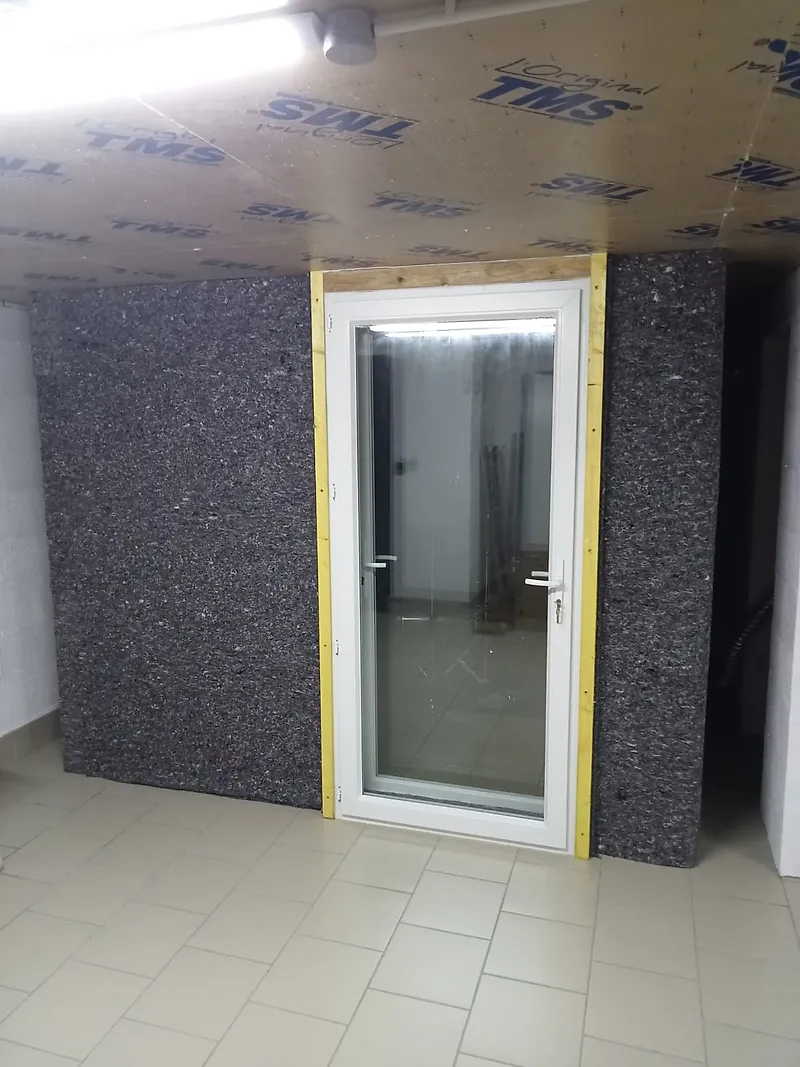
It also explains a limit that has to be faced. On a wall of 200 kg/m², another 200 kg/m² would be needed to gain 6 dB. A 20 mm textile mat weighs 1.8 kg/m², less than a hundredth of what would be required. No thin material, whatever it is and whoever makes it, will win through mass. Anyone promising the opposite is selling a disappointment.
What beats the mass law is not a material, it is an assembly: two leaves separated by a cavity, what acousticians call a mass-spring-mass system. For the same total mass it does far better than a single wall, on two conditions.
- The cavity must be damped. Empty, it resonates and couples the two leaves again; filled with a fibrous or porous material, it dissipates the energy instead of transmitting it.
- The two leaves must not be rigidly connected. A blob of adhesive, a screw passing through or a continuous batten is enough to bring the assembly back towards the behaviour of a single wall.
That is the exact place of a thin acoustic insulation: not the mass, but the damping of the spring. A modest role on paper, decisive in the result.
What the laboratory measured, exactly
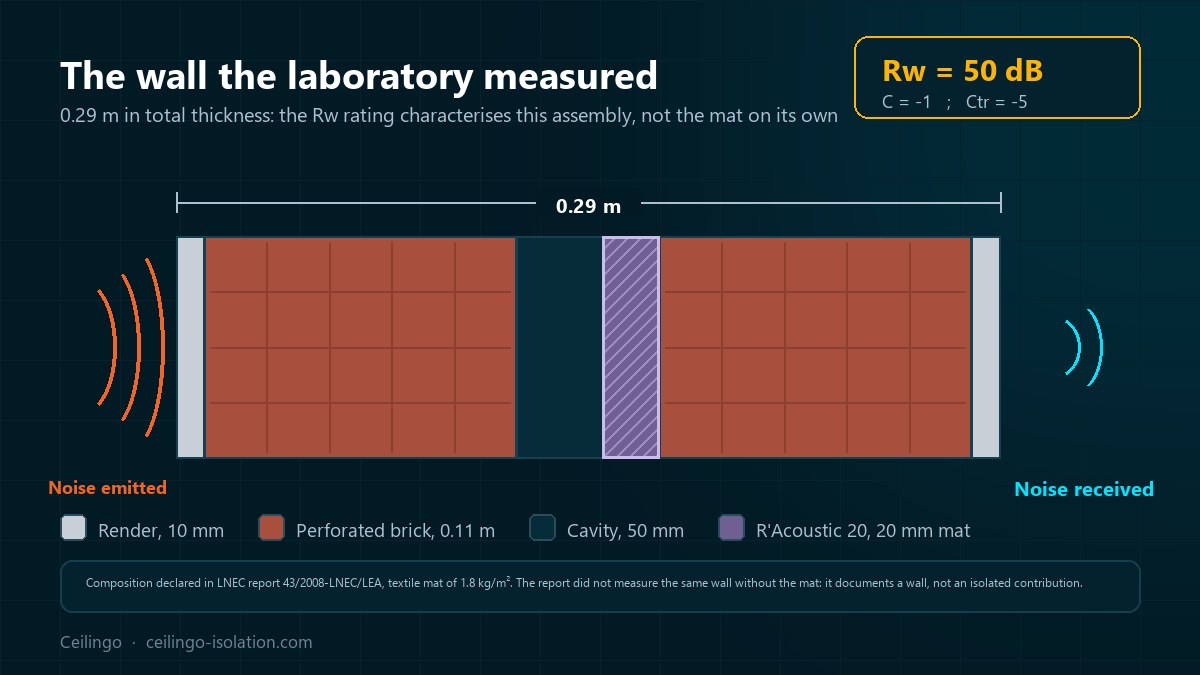
The National Civil Engineering Laboratory in Lisbon measured, on 21 July 2008, in its report 43/2008-LNEC/LEA, a double wall 0.29 m thick in total, mounted between two reverberation chambers of 121 m³ and exposed to pink noise, at 20 °C and 60 % relative humidity, in accordance with NP EN 20140-3.
| Layer | Thickness |
|---|---|
| External render | 10 mm |
| Perforated brick | 0.11 m |
| Cavity, partly filled with a 20 mm textile mat of 2 kg/m² | 50 mm |
| Perforated brick | 0.11 m |
| External render | 10 mm |
| Total | 0.29 m |
Result, in accordance with EN ISO 717-1: Rw = 50 dB (-1 ; -5). The sample appears in the report under its factory reference, 508, the one we sell as R'Acoustic 20. A point of detail: the report takes a surface mass of 2 kg/m² for the mat, where the product data sheet states 1,800 g/m².
This figure characterises this wall. The report did not measure the same wall without the mat, so it does not isolate the product's own contribution, and we do not claim it. What it does document, and that is already a great deal, is an ordinary double wall, with its cavity filled, measured by a public laboratory.
Two masonry leaves, a filled cavity, 0.29 m in total for 50 dB: mass does most of the work, the filled cavity makes the difference between a good wall and an ordinary one.
The weak point is always in the low frequencies
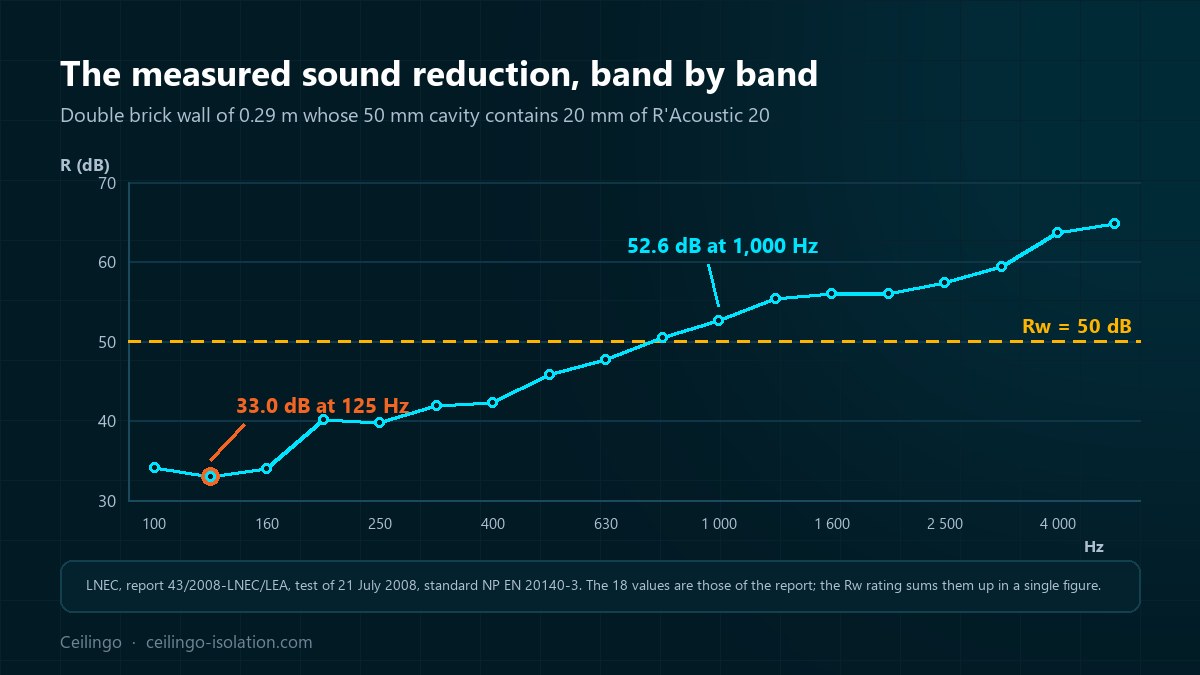
The single figure hides the most interesting part. Band by band, the same wall goes from 33.0 dB at 125 Hz to 52.6 dB at 1,000 Hz, then to 64.8 dB at 5,000 Hz. Close to 32 dB between the low and the high frequencies, on one and the same wall.
That dip is what the term Ctr quantifies, here at -5. A wall can filter a conversation perfectly well and still let a subwoofer, an engine or an idling lorry through. The classic complaint of the neighbour who hears the music without making out the words comes from this, and no thin covering will correct it: low frequencies call for mass, for distance between leaves and for decoupling.
Before choosing anything at all, you therefore have to listen to the nuisance. Voices and a television are a mid-frequency problem, which a well designed lining can handle. A home cinema or a drum kit is a low-frequency problem, dealt with through thickness and mass.
Choosing a thin acoustic insulation, then not spoiling the result
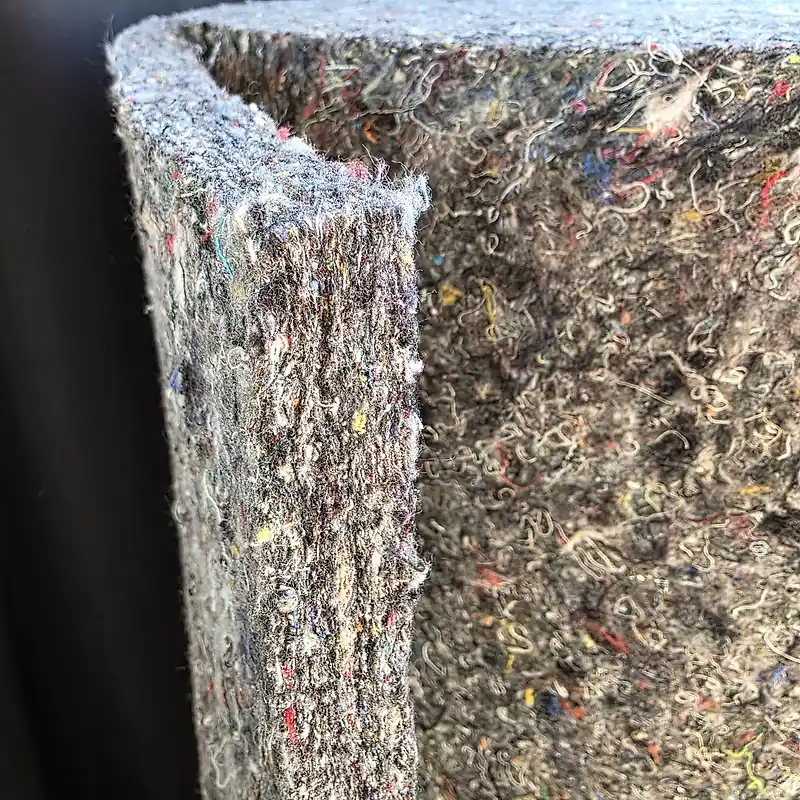
The R'Acoustic range is made of recycled textile fibres, wool, cotton and synthetic fibres, woven without adhesive for the first two references, thermally bonded without adhesive for the third. Densities follow the use: 90 kg/m³ for R'Acoustic 20, 110 for R'Acoustic 10, 130 for R'Acoustic Alu. Compressive strength exceeds 2 t/m², which allows it to be laid on the floor, under a levelling screed, without risk of crushing.
| Situation | Product | Measured benchmark | Source |
|---|---|---|---|
| Airborne noise: party wall, studio, home cinema | R'Acoustic 20 | Double brick wall of 0.29 m at Rw = 50 dB (-1 ; -5); 20 mm, 90 kg/m³, 1.8 kg/m² | LNEC 43/2008-LNEC/LEA |
| Airborne noise when every millimetre counts | R'Acoustic 10 | 10 mm, 110 kg/m³; indicative manufacturer's attenuation | Manufacturer's data |
| Wall lining or under screed, with a vapour barrier | R'Acoustic Alu | Dynamic stiffness s' = 16 MN/m³, ΔLw from 27 to 33 dB depending on the screed; E-s1, d0 | CEIS Madrid CAT0109/12 |
| Underlay for floating floors | R'BULL Pro 5s | 5 mm, aluminium on both faces over polyethylene foam | ETA 22/0178 |
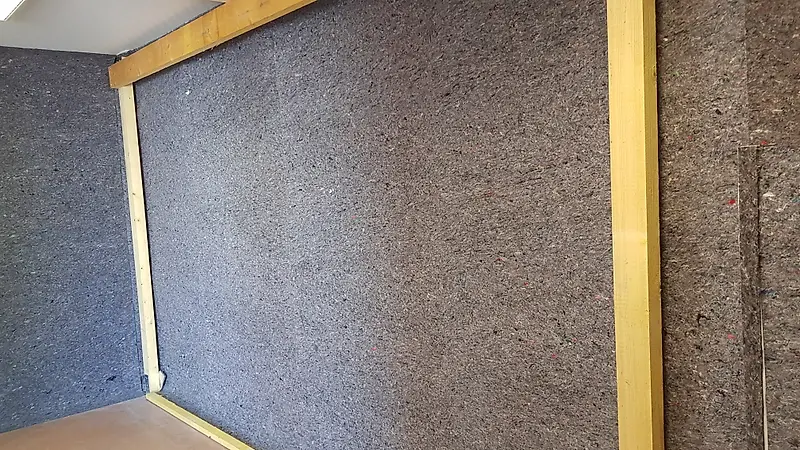
Installation is simple and holds no surprises: butt-jointed strips, fixed with a pneumatic nailer or staples, then a finishing layer, plasterboard, a masonry partition or a screed. In French buildings open to the public, R'Acoustic Alu is classified E-s1, d0 and is therefore laid behind a thermal screen, as required by article AM 8.
The mistakes that cancel the gain
A well chosen lining badly installed gives less than an ordinary lining installed well. The faults that come up most often:
- sockets and electrical boxes placed back to back on either side of the wall;
- ducts, pipework or an access hatch running right through the wall;
- a lining bonded with over-generous adhesive dabs, recreating a rigid link between the two leaves;
- a cavity that is too narrow, which pushes the resonant frequency of the system up into the useful band;
- the junctions with the floor, the ceiling and the cross walls, through which sound goes around the wall without ever passing through it.
That last line is the most expensive one. Treating a party wall without looking at the floor that crosses it often means paying for a lining and getting three decibels. Our technical support examines the wall and its junctions before proposing a thickness.
What the texts say
- French order of 30 June 1999 on the acoustic characteristics of residential buildings: DnT,A of 53 dB between dwellings, 55 dB from a garage, 58 dB from a commercial space, impact noise of 58 dB, façade of 30 dB
- French order of 30 June 1999 on how the acoustic regulation applies: DnT,A obtained by adding the term C, DnT,A,tr by adding Ctr, measurement uncertainty of 3 decibels
- ISO 717-1:2020: calculation of Rw and of the spectrum adaptation terms C and Ctr
- ISO 10140-2:2021: laboratory measurement, flanking transmission suppressed, results not transferable as such to site
- LNEC report 43/2008-LNEC/LEA of 21 July 2008: double brick wall of 0.29 m with 20 mm of R'Acoustic 20, Rw = 50 dB (-1 ; -5)
- CEIS Madrid report CAT0109/12: dynamic stiffness of R'Acoustic Alu and impact noise reduction under a screed
Frequently asked questions
What thickness is needed to soundproof a wall?
There is no standard thickness, because thickness is not the quantity that governs the result. What counts is the mass of the wall, the presence of a damped cavity and the absence of any rigid link between the two leaves. Twenty millimetres placed inside the cavity of an independent lining change the behaviour of the whole; the same twenty millimetres bonded to a solid wall change it hardly at all.
Is thin insulation enough against noise from neighbours?
On its own, no, and we do not present it that way. A product of 20 mm and 1.8 kg/m² brings no mass, therefore no sound reduction through the mass law. Its place is inside a lining or an independent partition, where it fills the cavity and removes its resonance. That is the configuration in which R'Acoustic 20 was measured by LNEC.
What is the difference between Rw and DnT,A?
Rw describes a building element measured in a laboratory, in a facility where flanking transmission is suppressed. DnT,A describes a result obtained on site, between two real rooms, flanking transmission included, and corrected for the reverberation time of the receiving room. It is DnT,A that French regulation requires, and DnT,A that an inspection measures. Moving from one to the other calls for a prediction calculation to EN 12354-1.
Why can you hear the bass but not the words?
Because a wall does not reduce every frequency in the same way. On the wall measured by LNEC, sound reduction goes from 33.0 dB at 125 Hz to 64.8 dB at 5,000 Hz. The spectrum adaptation term Ctr, here -5, puts a precise figure on that weakness in the low frequencies. A subwoofer or an engine is dealt with through mass and distance between leaves, not through a surface covering.
Does R'Acoustic deal with impact noise?
Impact noise falls under EN ISO 717-2, separate from the Rw rating. R'Acoustic Alu is the product documented on this point: a dynamic stiffness s' = 16 MN/m³ measured by CEIS Madrid, from which a calculated impact noise reduction ΔLw of 27 to 33 dB is derived, depending on the density of the sand and cement screed, in accordance with EN 12354-2. R'Acoustic 20 and R'Acoustic 10 target airborne noise first.